Author: Caroline Burns

Independent Board Director | Executive Advisor | SME Governance & Growth | International Business | Future of Work

The Firm That Forgot How to Think: The Competitive Risk Your Board isn’t Discussing

Remember when we worried that Google would make us shallow thinkers?

Our brain capacity is finite – so augmentation and amplification is inevitable – but augmentation in the way that we add another floor to an existing building: it requires a strong foundation to safely handle the additional load.  This is not the same as using a calculator for arithmetic we could do in our heads.  The distinction is whether you’re extending capability, or atrophying it by replacement.

The technology itself is neutral. The distinction lies entirely in intent: are we using AI to bypass the hard work of learning, or to extend and accelerate our capacity to be curious, insightful, and skilled?

Firm that forgot how to think

Because all organisations rely to some degree on human capabilities – intellectual, emotional and physical.   This is amplified in professional services and creative businesses such as management consultants, lawyers, accountants, engineers, and advertising agencies.  Since employee-related costs typically account for at least two-thirds of operating costs for a professional services firm (PSF), claims that AI agents can accelerate project timelines by 40% to 50% and reduce costs by over 40% create a stark choice between competitiveness and quality.

According to Marty Chavez, former CFO, CIO and global co-head of securities at Goldman Sachs, it’s a mistake for professional services firms to say “How am I going to defend business against AI?” – the better question is how they can ”reconceive what it means to deliver those services.”

Case in point: McKinsey is rolling out its proprietary AI platform Lilli across 45,000 employees, enabling consultants to do “in minutes what it would have taken them weeks to do.”  The efficiency gains are real. But so are the risks.

Last year, Deloitte agreed to refund part of a $440,000 consultancy fee to the Australian government after a report it delivered included AI-generated fabricated academic citations, false references, and a quote wrongly attributed to a Federal Court judgment.  Deloitte maintains the substantive findings were unaffected. Clients and courts are increasingly unlikely to accept that distinction.

This article is not a board primer on AI risk and opportunity — there are plenty of those.

It is focused on a slower, quieter risk: that in our urgency not to be left behind, we gradually unravel the very thing that makes our firms worth choosing. Our people. And in doing so, we blur our identity as an organisation — indistinguishable not just from competitors, but from every other AI-assisted business in every other sector.

My aim is to widen the perspectives of the boards, leaders, and business owners I work with — so that AI is not seen merely as something requiring a policy, but as a tool that can amplify your firm’s unique competitive advantage. Getting that right may take years, and its value may only become clear in hindsight. Which is precisely what boards are for.

To do that, I will first recap the key business risks of AI integration in knowledge-based firms — in particular the emerging concern around cognitive outsourcing. Then I will set out the strategic considerations for AI stewardship that genuinely intensifies the value of your people, the work they do, and their engagement with it.


The Fragility of Expertise in the Age of AI

For firms relying on knowledge workers AI integration presents four critical risks: from professional malpractice and reputational damage, to the long-term erosion of expertise, and the breakdown of traditional talent development.

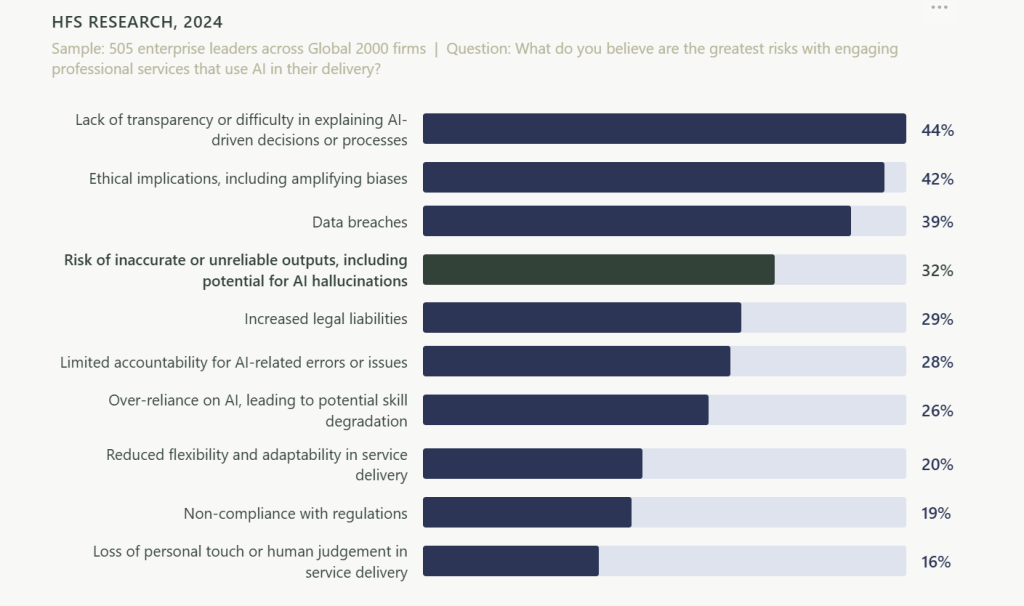
AI Risks of Hiring a Professional Services Firm - HFS Survey
The critical risks with engaging professional services that use AI in their delivery as perceived by Clients – HFS Survey

1. Inaccurate Deliverables and Professional Malpractice

Approximately 60% of firms recently surveyed have no AI governance plan, leaving them vulnerable as courts and governments begin introducing binding standards and AI-usage clauses in contracts.  The Deloitte case – a $290,000 lesson in what happens when professional judgment is replaced by blind trust in AI – is not an isolated warning. Failure to disclose AI use can lead to fee refunds, court sanctions, and fines.

There is also a subtler risk: employees may not have the expertise you believe they do.  Research shows 90 percent of job seekers who used AI to craft resumes said they felt confident applying for roles they weren’t qualified for.  Their work is faster, but surface-level.  Where nuance, originality, or judgment is required, the capability is not there.

2. Erosion of Trust and Authenticity

Clients pay premium rates for human insight and unique perspective, but when individuals replace professional judgment with uncritical trust in AI, this is cognitive outsourcing, and risks professional malpractice.  However it is not the same as intellectual misrepresentation.  If I ask AI to produce a report and I sign my name to it as though it were wholly my reasoning, that is misrepresentation.

Over-reliance on AI in client communication can also make professional relationships feel impersonal, and transactional.  Clients may eventually value a firm less if they perceive the advice they receive as formulaic or soul-less.

The blurred motivations within AI also present risk.  Stuart Russell, professor of computer science at UC Berkeley, and co-founder of the International Association for Safe and Ethical AI, warned in his TIME100 AI speech that we have no idea whether training large language models to imitate humans results in the AI absorbing human-like motivations – such as self-preservation and self-empowerment – and pursuing those goals independently.

3. Erosion of Focus, Professional Judgment and Complex Reasoning

Judgment and finesse are developed by thinking through choices, debating alternatives, and observing outcomes. Relying on AI for ideas, analysis, and decisions sacrifices the learning gained from that process – leaving professionals unable to explain or defend choices they did not actually make.

Unfortunately there is growing evidence that consumption of AI-derived content is contributing to a decline in reading comprehension and sustained focus.  Even at elite US colleges, many students now arrive unprepared to read a complete book, interpret a poem or follow a complex argument.

Writing, too, is a form of thinking.  Outsourcing it prevents people from learning to express themselves – or discovering what they want to say – because they lose the ability to distinguish their authentic voice from the formulaic.

All of this compounds into cognitive atrophy.

4. Loss of Tacit Knowledge

AI is highly effective at automating the codified, checkable tasks (the “bottom rung”) traditionally performed by entry-level workers, reducing demand for early-career workers in AI-exposed fields.  But AI does not just remove tasks.

“AI is steadily eating away at the training ground that entry-level work used to provide….[The risk is] building a generation of workers who are credentialed but unseasoned, creative but untested.” (Adam Monago, The Missing Rung: AI and the Vanishing Entry-Level Job, 22 September 2025).

Past generations learned judgment by doing: rewriting a draft for the third time, reconciling a messy spreadsheet, shadowing a mentor through a difficult client meeting.  If young workers are not tasked with these foundational activities, they may never develop the tacit knowledge they need to become the next generation of experts: the unwritten rules, cultural context, and complex judgment that cannot be taught in a classroom or generated by a prompt.

By 2030, many professions may face a shortage of senior leaders capable of operating below the AI abstraction layer – a generation of “architects who have never laid a brick.”

Practical Strategies for Firms: Protecting and Amplifying the Value of Your Expertise

To mitigate the risks of AI integration eroding competitive differentiation, innovation capacity, and sustainable talent regeneration,

we must shift the internal conversation in the organisations we govern, from “producing the same or more with less”, to “producing superior output with the talent we have.”

Here are three ways you can protect your firm against declining standards of value creation, and increased reputational and financial risk.

1. Governance Controls

  • Mandatory disclosure: Boards should enforce a “default to transparency” mindset — discovery of hidden AI use through audits or leaks can permanently destroy client trust. Make AI disclosure mandatory in all client contracts, specifying which tools are used, and require attestations of human review for high-stakes deliverables.
  • Separate creation and review: Establish a procedural or physical separation between the individual prompting the AI and the person validating the output. Fresh eyes are essential for catching AI hallucinations that the original drafter may overlook due to anchoring bias.
  • Traceability standards: Every claim or citation in a report must be traceable to human-verifiable sources – to prevent the submission of fabricated evidence or invented court references.
  • Consistent methods: Consider establishing a reusable library of blueprints and standardised criteria to avoid “uncontrolled agent sprawl” and support internal audit trails.
  • Escalation and crisis protocols: Boards must define clear escalation protocols for AI failures: who investigates, who notifies the client, and how to remediate it.

2. Performance and Motivational Alignment

  • Shift from headcount to outcome metrics: Boards must expand success measures beyond cost-savings to include competitive advantage and quality of output – ensuring firms do not cannibalise their transactional work at the expense of long-term expertise. Reward employees for skill and judgment, not just speed.
  • Redefine performance management: Include metrics for AI leadership and supervision – for example, how effectively an employee tracks, challenges, and corrects AI-generated work.
  • Ethics and literacy mandates: Mandatory AI literacy training should ensure staff can recognise the “illusion of thinking” in complex reasoning models and understand model-specific limitations.
  • Bias recognition and reflection: Professional services firms are already using generative AI evaluation tools that help managers recognize their own biases and synthesise feedback more accurately. Reflection prompts after complex decisions – “What was your most difficult moment?” or “Where were you uncertain?” – can build intuition and risk tolerance over time.

3. Safeguarding Tacit Knowledge

I consider this the most critical – and most overlooked – strategic response to AI integration at board level.  The savings from automating tasks and processes can be material and measurable.  The cost of eroding your firm’s knowledge and hands-on learning is delayed, but potentially catastrophic.

To mitigate the risk of the “bottom rung” of the career ladder breaking in your firm, work with HR on strategies that actively build tacit knowledge – especially for early-career employees – to ensure that the judgment, cultural context, and unwritten rules required for senior roles are sustained over time.

  • Treat knowledge continuity as a risk management issue: At board and leadership level we are focused on risk mitigation, including reputational, safety, privacy and business continuity.  Knowledge continuity deserves the same approach.  Structured offboarding and mentorship programs designed to transfer expertise rather than just tasks, and graduate apprenticeship models can extend and preserve institutional knowledge before it disappears.

Start by asking team leaders and managers to identify “high-value moments” of knowledge transfer in their work – project retrospectives, complex handoffs, problem-solving discussions.  These interactions expose unrecorded workarounds, expert intuition, and the hidden rationale behind complex decisions to less experienced team members.

As AI becomes increasingly relied on for basic tasks, new entry-level programs should not be primarily about producing output – they should be about evaluating it.  Structured, AI-augmented apprenticeships, where new-starters oversee, test, and correct AI output and manage escalations, train early-career workers on real consequences and complex downstream problems.  This increases their value as a necessary complement to automation, and builds the experience base required for more senior roles in future.

  • Formalise and structure mentorship – don’t just assign a mentor: According to Gallup, employees with formal mentors are 75% more likely to strongly agree their organisation provides a clear plan for their career development, compared to those with informal mentors.  Unstructured mentorship risks missing the why, as employees are mostly exposed only to the what of the situations and conversations around them.  Every senior professional should be expected to mentor junior colleagues as a core job responsibility.  This requires equipping experienced professionals with the skills to transfer tacit knowledge, give effective feedback, and create genuine learning opportunities.
  • Flip the mentorship model intentionally: Research shows nearly two-thirds (62%) of Gen Z employees are actively helping senior colleagues upskill in AI – continuing the reverse digital mentoring that first emerged between millennials and their managers in the early 2000s.  Both people benefit: 72% of Gen Z respondents said their AI skills have improved team productivity, while 57% of  senior colleagues reported having more time for strategic work as a result.  Importantly, this approach also acknowledges younger employees’ value and gives them a compelling reason to stay engaged.
  • Use developmental tasks and smart coaching : Project management tools such as Jira can incorporate smart coaching to suggest stretch tasks, such as recommending a team leader assign a graduate to stakeholder communications once they have mastered analysis reporting.  In coding-related roles AI-driven exercises can simulate real code changes, requiring trainees to identify logic flaws or insufficient testing.

Conclusion

The firms that will lead in 2035 are not the ones that cut costs fastest in 2025. They are the ones that used this moment to deepen their knowledge infrastructure, strengthen their talent pipeline, and build a culture in which AI amplifies human capability instead of replacing it.

As Tali Sachs has observed, companies risk training a generation of professionals who know how to get answers, but not how to question them.

Imagine the alternative: a pipeline of talent that grows from entry level through to expert, leader, mentor, and role model – building social, judgment-based, and technical skills at every stage of that journey.

That pipeline does not build itself. One well-structured program, consistently applied, can ripple across an entire workforce.

The boards that ask hard questions about knowledge continuity today are the ones whose firms will still have genuine expertise – and genuine competitive advantage – a decade from now.


If this feels worth exploring further, I’d welcome the conversation.

Caroline M Burns


This article was originally published in the April edition of my newsletter The Regenerative Edge.

Future of Work, Future-focused Leadership, Strategic Competitive Advantage, Transformation and Technology

You Don’t Need to Be Big to Go Offshore – But You Do Need a Plan

Expanding into an international market can be one of the most rewarding – and risky – moves a small or mid-sized business can make.  While global opportunities may seem within easier reach than ever, success offshore requires far more than ambition and a great product or service.

This article explores the practical realities of international expansion for SMEs, including why a well-prepared business case is essential, the key elements it should contain, and the critical decision points you’ll face from initial feasibility through to full market entry.  Whether you’re eyeing your first overseas customer or planning a broader strategy, this is what you need to know before you go.

You Don’t Need to Be Big to Go Offshore -But You Do Need a Plan


Why You Should Do a Business Case

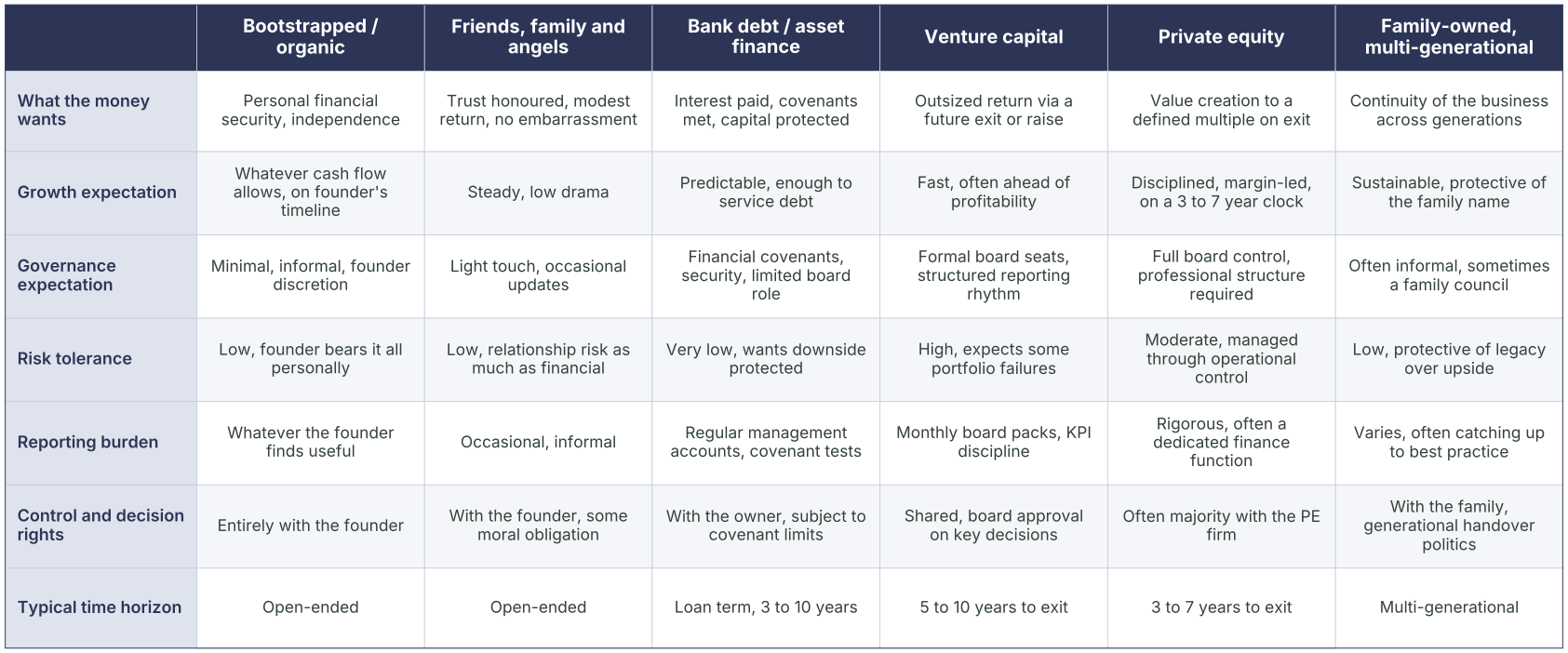
In “Get bigger or get out of the way: an insider’s guide to navigating strategic growth for mid-sized firms” I discussed the need for SMEs to maintain competitiveness through strategic growth, and the unique advantage most have in using culture to advantage as an M&A value-multiplier.

Whether you are considering expanding through M&A, or via direct entry into new markets, you need a business plan.

This guide for leaders and boards of SME’s focuses on the additional complexities and considerations your business plan needs when you explore overseas growth potential.

  1. It adds rigour and structure to the search, and is good governance especially if you have more than 1 decision-maker, or a current or future partner or investor
  2. It provides a logical and efficient process for evaluation and progressive decision gates
  3. If others are involved in contributing to the business case, it encourages broader ownership of the final decision and its successful implementation
  4. Regardless of the expansion outcome, and especially if it is not successful, the business case is a valuable post-implementation reference for assessing what worked and what didn’t, documenting the learnings and laying the foundation for a more successful expansion strategy in future.


The Essential Ingredients

  1. WHY – what you want to achieve through overseas market expansion. Be as specific and detailed as you can about the benefits.  Expansion is a long term and often significant investment, so knowing why you are doing it helps you stay the course when tough decisions are needed.
  2. WHERE you might go and with what products/services. This is all about context and competitive positioning.
    • This is where you need to be very realistic about whether this market(s) is right for your business and to what extent. Leave the emotion/intuition out of your assessment and seek external perspectives to balance your own.
    • Recommend assessing 2-3 markets which you feel might offer the benefits and are relatively similar – you might be surprised at the benefits of an option that wasn’t top of mind. Assess where/if your local competitors expand and try to understand why – they may have information or resources you don’t, or maybe they see the same potential as you.  Think about whether their decisions signal opportunity or threat.
    • Know exactly who your competitors are and why, assess their business model as best you can. Local or international?  It may be very different to yours, and there could be a very good reason for that e.g. technology adoption and platforms, infrastructure or supply chain logistics could be more or less advanced, complex, or regulated than in your home market.
    • Leverage your local partners/suppliers/customers with contacts in these markets. Go see them on the ground and talk to them to complement the extensive desktop research you will have done before this.  Walk around and observe, get a feel for customer/client behaviour and how they value and purchase similar products/services.
    • The first desktop assessment must be comprehensive, when you think you’ve dug enough, keep digging! You know what matters in your market, don’t make any assumptions.
  3. WHAT – it will cost and when you might make a return. Allow at least a year to break even and 2 years to make a profit, depending on business cycle times and whether you are in a business with high barriers to entry.  If you make money sooner, great, but it’s prudent to have the cash to fund a longer runway.
    • Leaving a market creates a very bad impression locally – you will damage your reputation and may find locals don’t take you seriously if you decide to go back in future.
  4. HOW you will enter the market, WHO will be your local people and supply chain/partners and WHEN you will go live. Don’t be afraid to decide the timing isn’t right and to postpone implementation.  It’s better to delay than to fail.
    • This is also the time to document a thorough risk assessment and ensure you have contingency plans and mitigation options. Be overly cautious especially if you are replying on local partners – while your contracts should be watertight, they can also be ignored – especially at a distance.
    • Don’t underestimate the difficulties and complexities of navigating different business cultures and languages – doing business with people locally is a very different experience to being a business visitor or tourist!

Once you’ve established the “why,” the research you’ve gathered helps shape and refine the business case, guiding more focused decisions at each stage.

Whether this is you as a founder/owner, a senior leadership team reporting to a private equity partner, or a board, treat the process as progressive and slightly iterative – allowing for regular check-ins, refinements, and, when necessary, course corrections.

At each key milestone, seek input, test assumptions, and make sure you have the data needed before advancing to the next stage. Expanding overseas requires time, investment, and attention—and it will inevitably draw focus from other areas of your business.

That’s why a disciplined approach is critical: if the right decision is to not proceed, it’s far better to discover that early than after significant resources have been committed.


What the Business Plan Helped One Firm See Clearly – and succeed as a result.

When I was approached to establish and lead the Asian operations of an Australian-based firm one of the first things I asked was “can I see the business plan?”   There wasn’t one.  So the CEO and I put together a roadmap for developing a 4-phase  business plan over 4 months, with a report to the board to seek clarity, direction, and approval to continue at the end of each phase.

Aside from all the obvious benefits I’ve outlined above, the business planning process yielded 4 other important insights that helped us avoid failure:

  1. WHERE we first planted our flag
  2. WHAT our optimum client mix was and HOW we could leverage clients across continents
  3. HOW we integrated our business culture (a competitive advantage) and WHO our people would be
  4. WHEN we went and what signals we needed to stay/go

WHERE we first planted our flag

When I was first approached, the executive team was pretty set on Shanghai as our first move into Asia.  There had been a small project there – not quite in our core service – but China was booming, and competitors were planting flags in Shanghai, often skipping Hong Kong altogether.

Still, a solid business plan needs fresh eyes.  So, in Phase 1, we widened the lens and included Singapore and Hong Kong.  After deep research, local visits, and stakeholder chats, we ranked the cities for the board.

The results?

The board chose Singapore, with Hong Kong as backup.  It turned out to be a great decision.

The key takeaway: it wasn’t that Shanghai was wrong, but that past experiences and market buzz can blind us to better fits.  Over time, working across Asia, it became clear that China wasn’t ideal for our niche model – while a Singapore base let us deliver value, take fewer risks, and build stronger regional partnerships.

WHAT our optimum client mix was and HOW we could leverage clients across continents

When we first started mapping out the business plan, we assumed our existing institutional clients would help anchor our growth in Asia – after all, many had offices in Hong Kong, Shanghai, and Singapore.  But once we dug in, we realised those regional offices were relatively small, with limited, locally owned project budgets.  On top of that, local leaders had their own preferred partners, making it tough to break in.  It was a humbling early lesson: success in a new market can’t rely on old assumptions about client behaviour.

HOW we integrated our business culture (a competitive advantage) and WHO our people would be

Culture was one of our biggest competitive advantages, but when I was tapped to launch the Asia business, I quickly realised I didn’t fully grasp all the nuances, rituals, language, and unspoken ways things got done.  To help bring that culture with us, we invited team members to relocate and help seed it locally.  Out of hundreds of employees across Australia, only one person seriously considered the move.  What we hadn’t accounted for was how much our Aussie culture valued lifestyle, familiarity, and being a “big fish in a small pond.”  Luckily, that one applicant was exactly who we needed – someone who truly lived the culture and helped translate it into our new regional team.

WHEN we went and what signals we needed to stay/go

After choosing Singapore, we got to work – building the business plan, having early client conversations, and lining up what looked like a major first project that would cover much of our startup costs.  Then the global financial crisis hit, and that project disappeared overnight.

Still, we’d done the groundwork, knew the market potential, and had budgeted for a first-year loss.  Even with the uncertainty, the board backed the plan, and I relocated as scheduled.  It took a full year to land our first big project, but starting early gave us a head start – while others waited out the GFC, we were building relationships, learning the landscape, and proving we were serious about Asia.


Why the Business Case Mattered More Than We Knew

Looking back, the detailed business planning process gave us far more than a roadmap – it helped uncover blind spots, challenge assumptions, and build early credibility in the region.  We learned quickly that relying on global client relationships wouldn’t be enough, that culture doesn’t automatically travel, and that market entry requires deep local insight and patience.

Even when the GFC threw a wrench in our early plans, the groundwork we’d laid gave us the confidence – and resilience – to move forward.  That preparation gave us a real edge: we entered the market informed, intentional, and a step ahead of competitors who waited for more certainty.

A solid business plans get you through the door and maximises your opportunity for sustainable success.  But laying the groundwork is just the beginning.  Building an agile, scalable business is what takes you further.


If this feels worth exploring further, I’d welcome the conversation.

Caroline M Burns


Get insights and advice based on real-world experience in “Get Bigger or Get out of the Way: An Insiders Guide to Navigating Strategic Growth” and “Is Culture the Spanner in the Works of M&A?

Note some case study details have been changed or blended with other similar cases to protect confidentiality.

This article was originally published in the July 2025 edition of my newsletter The Regenerative Edge.

Board Foresight, Strategic Competitive Advantage, Successful SME

Is Culture the Spanner in the Works of M&A?

Culture – Culprit or Easy Scapegoat?

There are many reasons for entering into a merger or acquisition, and as many reasons why they succeed or fail.

But as we all know, many more fail than succeed in delivering net value.

And the same culprit shows up again and again in the research as a significant or the primary cause of M&A failure.

Culture.

Is Culture the Spanner in the Works of M&A?

Not surprised?  You shouldn’t be because this is the prevailing view, including from McKinsey who say their research shows that companies that manage culture effectively in their integration planning are around 50 percent more likely to meet or exceed their cost and revenue synergy targets[i].

Out of the 12 peer-reviewed (i.e., commercially unbiased) research papers I studied, 8 pointed clearly to culture as a key contributor to post merger failure. While these ‘yes’ papers tended to be qualitative or literature-based—often referencing high failure rates without extensive empirical data—they were nonetheless consistent in emphasizing culture’s role. Notably, not a single study dismissed cultural integration as an insignificant factor.

This reinforces a key reality of post merger transformation: while integrating processes, systems, and people is challenging enough, it’s the blending of two distinct cultures that often proves most complex. When mishandled, this cultural stitching doesn’t just slow progress—it can actively erode value.

Maybe culture is sometimes an easy scapegoat?

The remaining 4 papers I reviewed – two of these[ii] included a large meta-analysis and a recent quantitative study – found mixed results, highlighting that cultural issues can have both negative and positive effects depending on context and how management plan and implement the integration.

The risks and opportunities of an M&A are also influenced by how similar the companies are and the type of cultural difference, for example is it a cross-border difference such as between a Chinese and an Australian company or a management style culture between a more structured firm and a more empowering, less hierarchical firm?

Even within the same merger, culture can have simultaneously positive and negative effects in different areas, such as how well the companies blend socially, how effectively they achieve their goals together, and how shareholders are affected[iii].


Culture Lurks in the Depths

An Australian-based professional services firm I’ve worked closely with chose to expand through both organic growth and acquisition, with mixed results for each.  In a firm where “people are our competitive advantage” the major hurdle to the ‘where, what and how’ of expansion is “can we get good people?”

This qualifier can take certain growth options off the table, and can be a plus (and also a risk) for a merger or acquisition if there not is a substantial degree of cultural alignment.

The firm had successfully partnered on projects for national clients with a small firm in Perth that shared similar values and market positioning regarding client relationships and technical standards.  The firm was a partnership between a business leader and a creative technical expert.  An acquisition was agreed and in many respects worked well.

However, Perth has a very different business culture and perspective to the East Coast cities, and the office continued to operate relatively independently and often without the sense of urgency around business development and commercial project management that was ingrained in other offices.  Financial results became patchy as work wasn’t always sufficient to keep everyone busy, and long projects regularly ran over time and over budget.  Profits disappeared.

This wasn’t a capability issue it was a cultural issue.  The management culture was much more relaxed, targets were considered a guide rather than a mandate and entrenched behaviours and attitudes proved extremely difficult to shift – especially from over 3,000km away!  Eventually a transition to a new office business leader was instrumental in reinforcing the need to evolve the culture to be more closely aligned with the parent company and the benefits in doing so.

The firm encountered very different challenges expanding organically into a new market where there was no suitable M&A candidate (read more in this Successful SME Series post).  Noone internally had the capability, experience or entrepreneurial mindset to start a new business in a new location from scratch, so I was recruited to join the firm for this purpose.  Once the office was established we asked employees to indicate their willingness to move to the new office to ensure we transferred much of the unique culture and know how, and extended the social network.
Out of hundreds of employees we had one serious applicant.  The business culture and to a degree the Aussie culture valued lifestyle, community, familiarity and “big fish in a small pond” mentality to a degree we didn’t anticipate.  Fortunately for us and especially for me he was an exceptional technical leader who single handedly helped infuse the firms values, culture, standards and processes into the new regional business.

Culture as Competitive Advantage

There is an opportunity for mid-size firms to manage the cultural challenges of M&A more successfully than large or mega firms, for a few important reasons:

  • The nature of smaller firms tends to involve more people at more levels in the the running of the business (with some notable exceptions especially with entrenched owner-founders) so the likelihood of culture risks being identified early in the M&A process is greater. It’s also likely to encourage broader commitment to finding practical ways to minimise or address these issues.
  • Large firms may have an overarching culture, but their scale usually means distinct functional and locational subcultures and silos – complicating high level integration strategies. Silos and subcultures also inhibit the flow of information and knowledge through the organisation, further slowing cultural translation and transformation.
  • People in mid-size organisations frequently identify closely with their culture and values and see this as contributing to competitive advantage. They are more likely to have a nuanced understanding of the ‘informal culture’ and are familiar with the network of cultural influencers they can tap on to help drive integration efforts.


Culture Doesn’t have to be the Spanner

Culture is rarely the loudest voice in an M&A room. The financials, the synergies, the legal structures — these dominate the conversation. Yet time and again, it is the quieter, harder-to-quantify force of culture that determines whether a deal ultimately creates or destroys value.

The evidence is consistent, even if not always neat: culture matters enormously, its effects are context-dependent, and ignoring it is rarely a viable strategy.

As the Perth acquisition illustrates, cultural misalignment doesn’t announce itself on day one — it seeps through gradually, in missed targets, fraying accountability, and the slow erosion of commercial discipline. By the time it’s visible, the costs are already real.

But the story doesn’t end there. Culture can also be a powerful enabler — a source of alignment, trust, and shared identity that accelerates integration when handled with care and self-awareness. The spanner only stays in the works if you leave it there.

For mid-size firms in particular, there is a genuine and underutilised advantage here. Closer to their people, more attuned to their informal networks, and less burdened by the subcultures and silos that plague large-scale mergers, they are better placed to catch cultural risks early — and act on them. That proximity is not just an operational reality; it is a strategic asset.

The firms that will get M&A right are not necessarily those with the most sophisticated integration playbooks. They are the ones that treat culture not as an afterthought to be managed once the deal is signed, but as a lens through which every stage of the process — from due diligence to day one and beyond — is examined.

Culture isn’t the spanner in the works. Neglecting it is.


If this feels worth exploring further, I’d welcome the conversation.

Caroline M Burns


Parts of this article were originally published in the June-July 2025 edition of The Regenerative Edge.


References

[i] Ignacio Fantaguzzi, ‘The Importance of Cultural Integration in M&A: The Path to Success’, 1 February 2024, http://ceros.mckinsey.com/chapter-switchera-desktop-3.

[ii] Silin Ye et al., ‘Managers as the Bridge: How Cultural Friction Influences the Integration of Cross-Border Mergers and Acquisitions’, International Business Review, 1 March 2023, https://doi.org/10.1016/j.ibusrev.2023.102138;

[iii] Gunther K. Stahl and Andreas Voigt, ‘Do Cultural Differences Matter in Mergers and Acquisitions? A Tentative Model and Examination’, Organization Science 19, no. 1 (2008): 160–76, https://doi.org/10.1287/orsc.1070.0270.

Board Foresight, Culture and DEI, Strategic Competitive Advantage, Successful SME

Get Bigger or Get Out of the Way

An Insider’s Guide to Navigating Strategic Growth for Mid-sized Firms

Get Bigger or Get out of the Way: An insider's guide to navigating growth for SMEs
Get Bigger or Get out of the Way


Stuck in the Middle

During the course of my career I’ve spent a lot of time working with and within small and medium sized enterprises as an employee, leader, owner/founder, board director, and more recently also as an adviser/problem solver for CEOs and founder-entrepreneurs.  We are talking about businesses with 100-2000 employees, or smaller, high-turnover generating firms.

I compare the challenges these firms face to the challenges of the middle class in many economies: the super wealthy are accumulating more, and many in the middle are becoming poor or struggling more often.  What used to be the majority middle is being squeezed at both ends.

It’s a bit the same with mid-sized firms.

During the past few decades mergers and acquisitions (M&A) across all professions and industries have created mega-companies – the market share of the top four companies per industry increased by five percentage points between 2000 and 2019[1].  Increasingly this is the case in services and professions, not just industries with traditionally high barriers to entry such as digital tech and cloud computing, resources, manufacturing and pharmaceuticals.  Over the same period the proportion of workers around the world who are entrepreneurs, freelancers or micro business proprietors has also increased dramatically[2].

The mega firms have competitive advantages in market dominance or presence almost everywhere, diversified sources of revenue, price-setting power and supply chain negotiating leverage.  They compete on a vast economy of scale.

Small and micro businesses typically have low overheads, usually a high degree of specialisation or personalisation, often close relationships with customers and suppliers, and generally don’t have external investor or shareholder pressure to grow revenue and profits every year.  They compete on adaptability and stickiness but often struggle with productivity.

And the mid-sized businesses?

In my experience they risk having the worst of all worlds – they are neither large nor small, without the scale and dominance of global competitors or the agility and flexibility of their smaller competitors in local markets.

But…..they also have unique opportunities to provide a viable “third way” choice for employees and customers – if they play their cards right.


Your Competition is Global

If you are a director or executive with a mid-sized firm it’s risky to believe you have confined your operations to a domestic market, because you can bet many of your competitors are local offices of global companies, local firms who have been acquired, or joined international franchises or partnerships.

Your competition is probably global, even if your clients or customers are local.

When I was headhunted to establish and lead the Asian operations of an Australian-based firm I played a key role with our CEO in encouraging a shift away from this mindset.  Some of the most iconic companies in Australia were repeat clients of the firm, and competitors were primarily home-grown – although a few had expanded overseas with varying degrees of success.

However, convinced of the benefits and aware of the risks laid out in the detailed business case I prepared, the board backed international expansion.

Once we were firmly established in Asia our client demographic skewed towards multinationals, with regional decision-makers mostly based in Singapore and Hong Kong.  We were smart and built close relationships and were very successful at winning work.

However after the global financial crisis two shifts started to accelerate and converge.

The first was increasing centralisation and homogenisation of decision-making and procurement processes within multinationals, and the second shift was the accelerating acquisition of adjunct and aligned services by multinational competitors, who had spent the early years of the millennium merging into a handful of global full-service firms.

We worked with global clients, so we needed all the systems, processes, QA and compliance that the big guys needed, and we remained competitive and successful.  But with only 300-400 employees spread over 5 offices and a well-defined focus on core services, we had a diseconomy of scale in both pricing and central overheads.  We also lacked the ‘service bundling’ ability of the mega-firms and their network of influential relationships at the top of global hierarchies.

Smaller local competitors continued to challenge us with their lower cost base and ability to pursue smaller projects more efficiently.

I have lost count of the times I said during strategic planning workshops and as an executive director on the parent company board that we risked being stuck in the middle.

Not big or small. Not niche or full-service. Not local yet not global.

My fear was that over the time we would become less competitive, less sustainable and less attractive as a great place to work and a great firm to partner with.


You Might Kiss a Lot of Frogs

I could see this clearly from Asia, but it was less apparent from within Australia, if no less a real medium-term threat.  I wasn’t the only voice that suggested we needed to prune to become stronger and then shrewdly expand further, and at one stage the CEO and I seriously explored expansion of our Asian footprint.

We focussed on the increasingly active and maturing Hong Kong and Shanghai markets where we had experience and networks.  Planting a flag in the ground of Singapore had worked extremely well as a growth strategy, but for a number of reasons it was less likely to be successful in China.

In mainland China we had identified a firm with two well-established offices in Shanghai and Beijing, a single owner (easier to negotiate with), a highly capable and ambitious office director in Shanghai, complementary (and some same) clients, and with similar culture, values and competitive strategy.  Their two offices were not dissimilar in headcount to some of ours.

We received encouraging signs from the founder – who like me was an expat – and agreed to commence talks and in parallel engage in regular knowledge sharing to provide new professional learning opportunities and contacts for our employees.  Although the potential for an acquisition remained highly confidential, we both saw the employee engagement initiative as a good test of cultural connection and openness to new ways of doing things.

However, our negotiations fell through during early due diligence, mainly as a result of different expectations of shareholding and voting rights and to the restructuring needed to achieve efficiency gains, which was a key objective of any growth-oriented acquisition.

This was disappointing, but the right outcome.


Like Likes Like – Leveraging Mid-size Advantage

M&A’s can be an extremely effective way for mid-sized firms to improve competitive advantage by growing footprint, products and/or services, reducing competition and/or accessing new customers, or by increasing efficiency (eg by accessing new systems or technologies).

It can also create more nuanced value for both organisations in other important ways, such as:

  • Provide opportunities from strategy through negotiation, implementation and integration for emerging leaders to step up and gain visibility and valuable skills and learning;
  • Demonstrate to employees that the firm is committed to pursuing growth which can increase opportunities for promotion or movement into different locations or market segments;
  • Diversify the ownership base and potentially strengthen succession planning, particularly within the senior ranks;
  • Demonstrate to the customers, partners, competitors, employees and potential future employees that the company does not accept the status quo as being ‘good enough’ and strives to improve its ability to bring value to customers; and
  • Raise the organisations profile and provide marketing and PR opportunities.

While these strategic advantages of a mid-size acquisition can also benefit large and mega-companies, the effects can be diluted by their existing scale.  Also, the integration tends to be more complex, slower and often meets with more employee resistance as the benefits for them are less obvious.

Leaders of mid-sized firms are also often suspicious of the motives of mega-firms, and wary of the scale of cultural, structural and process change a take-over is likely to mean for their company and its people.  Many would prefer to engage with a partner where the size differential is smaller, making SME-SME M&A options more plentiful and attractive (at least on the face of it).


The Middle Ground is Full of Potential – For Now

The middle ground in business has never been more precarious – or more full of potential.  Mid-sized firms face real and growing pressure from both ends: mega-firms with their scale, reach and bundled services on one side, and nimble, low-cost specialists on the other. Standing still is not a neutral position; it is a slow retreat.

But as this article has argued, being mid-sized is not simply a disadvantage waiting to be resolved.  It is a distinct strategic position with genuine strengths – closer leadership, more agile decision-making, a clearer cultural identity, and the ability to pursue M&A partnerships where both parties see themselves as equals rather than predator and prey.  The failed China acquisition was not a setback; it was due diligence working exactly as it should.

The firms that will thrive are those that see M&A not as a panic response to competitive pressure, but as a deliberate, well-timed tool for building a stronger, more differentiated business.

Done well, it accelerates growth, deepens leadership capability, energises employees, and sends a clear signal to the market that the firm is playing to win.

The strategic window for mid-sized firms is real – but it won’t stay open indefinitely.  As consolidation continues across industries and professions, the pool of attractive, well-aligned acquisition targets will shrink.  The firms that move with clarity and conviction now will be the ones that define the competitive landscape of tomorrow, rather than simply respond to it.

Get bigger, get smarter, or get out of the way. The choice, for now, is still yours.


If this feels worth exploring further, I’d welcome the conversation.

Caroline M Burns


This article was originally published in the June-July 2025 edition of my newsletter The Regenerative Edge.

If you would like to read more on the cultural aspects of merger and acquisition strategy, read this Sucessful SME post next.


Notes and References

Some company and situational details in the examples shared have been changed or blended with other cases to protect confidentiality.

[1] Sara Calligaris et al., ‘New Approaches to Measure (Increasing) Concentration in Europe’, in CEPR, 2025, https://cepr.org/voxeu/columns/new-approaches-measure-increasing-concentration-europe; Rose Jacobs, ‘Rising Corporate Concentration Continues a 100-Year Trend’, Chicago Booth Review (Chicago, Ill.: Chicago Booth, 15 August 2022), https://www.chicagobooth.edu/review/rising-corporate-concentration-continues-100-year-trend.

[2] Anu Madgavkar et al., ‘The Rise of MSMEs (Micro, Small, and Medium Enterprises)’ (McKinsey & Co., 2 May 2024), https://www.mckinsey.com/mgi/our-research/a-microscope-on-small-businesses-spotting-opportunities-to-boost-productivity.


Board Foresight, Strategic Competitive Advantage, Successful SME
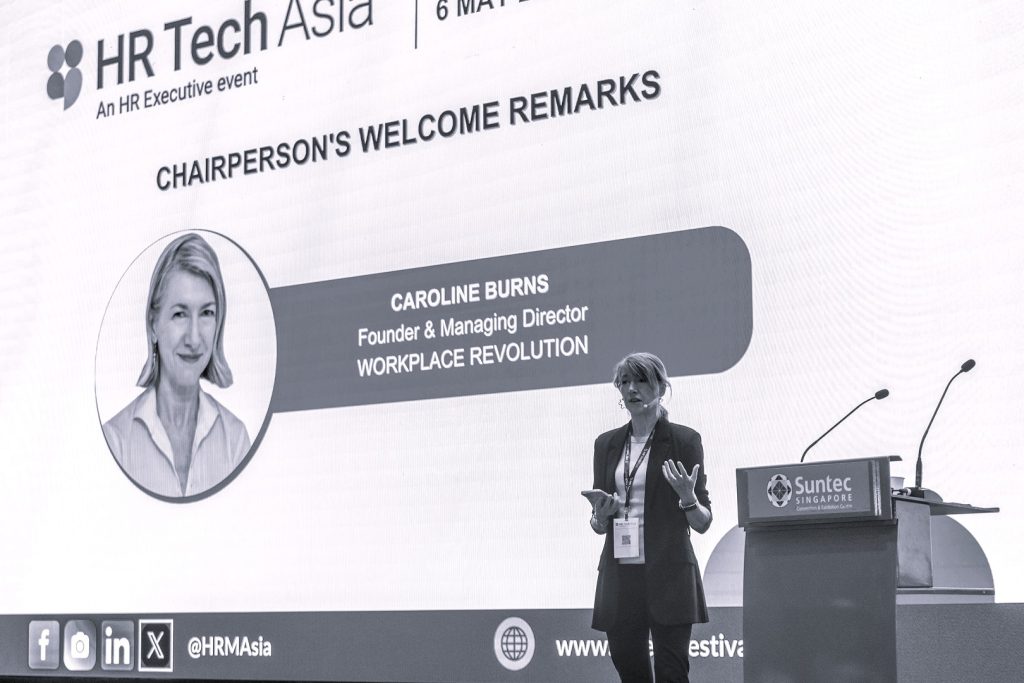
HR Tech Asia Summit – Chair’s Opening Session

Title:

HR tech Asia, WorkTech Excellence Track

Conference Chair:

Dr Caroline Burns

Event:

HR Tech Asia 2025

Date:

6-7 May 2025

HR Tech Asia Chair Opening Presentation

Chair’s Opening Session:

Hello! I’m Caroline Burns, your Chair for the  HRTech Asia Worktech Excellence Track today and tomorrow.

We are all here because the world of work is at inflection point.  Artificial Intelligence (AI) is part of the story – but not all of it.  Work and the technologies we use to organise, perform, monitor and evaluate work have been evolving rapidly since 2000, and the pandemic lockdowns five years ago accelerated changes in personal workstyles, employee expectations, communication, work process and performance management.

Every leader I speak with and board that I am part of is looking for opportunities within this evolution to improve people’s ability to perform and deliver increased value to customers.

This morning during the summit keynote we heard from HR leaders how to employ bold HR strategies to stay ahead of macro trends and the evolving world of work.  We learned about the five forces that are reshaping the foundations of people management, took peek inside next generation tools for HR digitisation and talent acceleration, and heard practical case studies and tips on transforming roles to meet evolving business needs.

During the remaining day and half of this summit the Worktech Excellence Track will build on these themes and drill deeper into future of work behaviours and workstyle transformation, featuring expert speakers and panelists on innovation & productivity, employee experience, flexibility and workplace wellness.

But before I welcome our first keynote, I’d like to share a couple of stories to illustrate the pervasiveness of this workforce transformation.

Anecdote 1 – AI versus Technician: the new imperative for problem-solving capabilities

I recently had a problem with a new induction cooktop we installed in our holiday house – it kept randomly yet stealthily turning off, which is a bit of a problem when you are trying to cook for family or friends!

Eventually we were able to get a technician authorised by the manufacturer to come and have a look.  And this Tradie ummed and ahhed and obviously had no idea how to diagnose what was wrong.  And admittedly he hadn’t worked on this model before, as it’s very new and not very common.

So, because he has no idea he orders in three new parts from Europe, one of which is the power control board which is effectively a chip with some fancy AI.

It takes 5 weeks to get the parts.

So, he comes back and replaces all three parts.  And the original problem is fixed – although we don’t know which new part(s) were responsible because all three were replaced at one then tested together.  But now we have a new problem – some of the hotplates don’t recognise when you put a pot on them.

Poor Tradie again has no idea, and his first thought is to try and leave, suggesting we monitor the situation over the next few weeks. Which doesn’t help us very much and only delays the inevitable.  So instead, we guide him through some trouble shooting and a process of elimination to try and diagnose the problem and hence find a solution.

And we do identify the new issue.  So now the induction works.

But that’s not the reason I’m telling you this story.

You’ve probably guessed the reason.

It’s because while the Tradie had some technical skills, he didn’t have what the World Economic Forum calls essential Future of Work cognitive capabilities of information gathering, analysis and problem solving.  Capabilities that we need now more than ever.

In an age when almost everything we interact with, even a humble kitchen appliance, is powered by computers, and increasingly by AI, we can’t expect the Tradie to know how the AI works or to keep up a constant barrage of new features and models.

But, what he should be able (and trained) to do is listen carefully to the customer, diagnose the problem through a series of questions and steps, and offer possible solutions.

These capabilities would improve customer experience, decrease costs and resolution times for his employer, and improve the likelihood that he will be able to maintain relevance and not be discarded on the skills scrap heap.

Anecdote 2: From wilderness bootcamp to workplace: preparing for the future of work with essential skills and attitudes

My 15 year old nephew in Australia is currently into the 3rd month of a compulsory six month school boot camp with 60 of his classmates (all boys).

Similar to national service here in Singapore without the weapons!

The boys are allowed only two short trips home in this time, and NO technology – no personal phones, no access to social media, no access to Google or Chat GPT[i].

The boot camp is held in the wilderness in a large boys boarding school and they have regular lessons, but academic learning takes a back seat.  Instead, the focus is all on building physical, intellectual, emotional and social flexibility and resilience.

Everything they do, from building bridges and boats, orienteering, mini-triathlons and three-day treks is with their dorm team.  And while the boys are supervised for safety, they are usually guided only by what they need to achieve and why, with no help on the how.  That’s up to a dozen 14-15 year old boys to figure out.

The teams are naturally highly competitive.

And they know the team is only as good as their weakest member.

They win together by working together, recognising that the collective work of the team will always be far superior to the individual skill or talent of a few members.

What they don’t realise they are learning are critical Future of Work attitudinal elements that underpin the confidence to achieve a goal – resilience, flexibility, self-awareness, motivation, curiosity and lifelong learning.[ii]

And the FoW cognitive skills – analytical thinking and creativity.

The school community knows from experience that instilling these capabilities at this age far outweighs the benefits of an additional 12 hours’ academic study every week for 6 months.

I am confident my nephew and his classmates will navigate the future of work with confidence.


The workforce of tomorrow, the people who will add real value to our organisations and help them respond, innovate and adapt in the face of ongoing uncertainty, complexity and ambiguity will need these essential cognitive and attitudinal strengths.

More than ever, these skills are needed to use AI intelligently and responsibly to enhance our potential, and not to replace our ability to think.

And this is why we are here, to equip ourselves as leaders with best practices, knowledge & ideas to help the people and organisation work with successfully navigate the journey of work transformation in the digital age.


Notes and References

[i] This was in early 2025 before the social media ban in Australia for under-16 year olds, so the boys were used to social media and increasingly AI being part of their daily lives.

[ii] World Economic Forum, The Future of Jobs Report 2023

Future of Work, People and Talent, Transformation and Technology

How to Transform ‘Office Work’ into ‘Knowledge Work’

Peter Drucker  first observed in a 1992 essay for Harvard Business Review that our great transformation to a society of knowledge workers would be completed by 2010 or 2020.  Unfortunately, organisations still struggle to optimise performance by recognising and enabling the key requirements of knowledge work laid out by Drucker almost 35 years ago:

“It is the knowledge worker’s decision what he or she should be held accountable for in terms of quality and quantity with respect to time and with respect to cost. Knowledge workers have to have autonomy and that entails responsibility. Continuous innovation has to be built into the knowledge worker’s job…[as does] continuous learning and continuous teaching.”
Peter Drucker, Knowledge-Worker Productivity: The Biggest Challenge, California Management Review 1999

Knowledge workers must have autonomy and accountability

Since the pandemic lockdowns almost five years ago, office-based workers are more confident to try new things, to solve their own problems and more aware of how they produce their best work.   We are starting to see the emergence of the knowledge worker as Drucker envisaged them – people who individually and in teams or project groups bring intelligence and a degree of autonomy to increasingly complex roles.

This complexity is not necessarily about technical expertise or skills, but increasingly driven by task unpredictability and diversity, information overload, resource scarcity and faster cycle times.

Whether the explosion in employee experimentation with large language models such as ChatGPT adds to or reduces complexity, or enhances autonomy, remains to be seen.[i]

In era of Industry 4.0, what we do we now define as successful performance for individuals, teams and organisations? 

I discussed these questions with my colleague and co-presenter Dr Richard Claydon from EQ Lab a few years ago.   Richard was a partner in Phrasia’s global  “Voice of the Crowd” research  into the work from home experience.   Their deep AI analysis of open-ended responses revealed strong narratives within shared themes and highlighted the complexity and uniquely individual experience of knowledge-driven work.

What work may look like in future must be driven by what we redefine as successful performance – and what the enablers of that performance need to do over time.

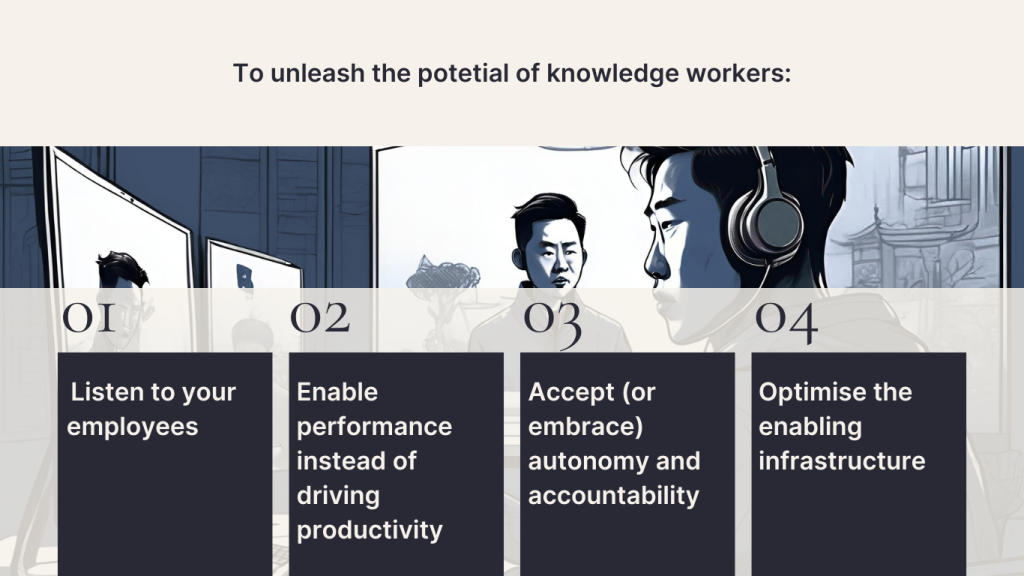
Four workstyle discussions between leaders and employees


1. Listen to your employees

They are increasingly aware of how they work best and what ‘effective performance’ means for them. 

Organisations are increasingly faced with customer and employee segmentation into smaller and smaller clusters.   Sharing responsibility for optimising the workplace experience at a granular level between organisations and individuals is likely to yield significant benefits for both.

Global research by ServiceNow  reveals that 92% of executives acknowledge they were forced to rethink how they worked during lockdown and 87% of employees said this new way of thinking about business was an improvement.   People were ‘forced’ to learn new skills in terms of technology and – more importantly for the future –  develop new capabilities, including learning and experimenting ‘as-you-go’, problem solving, decision-making, conscious communication, empathy, self-motivation and prioritisation, and leadership (at all levels and in many guises).

These are the critical skills widely acknowledged to be essential for knowledge work in the digital age.   Industry must invest in uplifting knowledge worker performance to improve productivity at organisational and national levels and stave off the stagnation that has encouraged cost-cutting and share buybacks to boost profitability.

These future of work skills are immensely valuable to individuals in terms of job security and to organisations seeking the optimum balance between humans and machines to be more insightful, more innovative, faster and more sustainable.

However, in the relentless drive towards efficiency many organisations have sacrificed knowledge worker performance and the ability to respond adequately to VUCA.   As Professor Lynda Gratton noted some years ago in a future of work conference keynote, we need to “listen to the job” and create environments that support the jobs of the future, not the jobs of the past.

If your organisation has been reluctant to engage and seek feedback from your employees until you ‘are ready’, you are probably going to be waiting a long time.   Seeking qualitative, anecdotal feedback is just as valuable as company-wide surveys. Ask what’s working and not working, not just when or how many days employees want to come back to the office (the responses to these questions can be very misleading – buts that’s a whole other article!).


2. Enable performance instead of driving productivity

If you only measure what happens in offices, it will be difficult drive a broader approach to supporting people’s best work anywhere.  

Ask HR if they are reviewing performance measurement, reward, and recognition policies to effectively support remote as well as ‘in-office’ work.

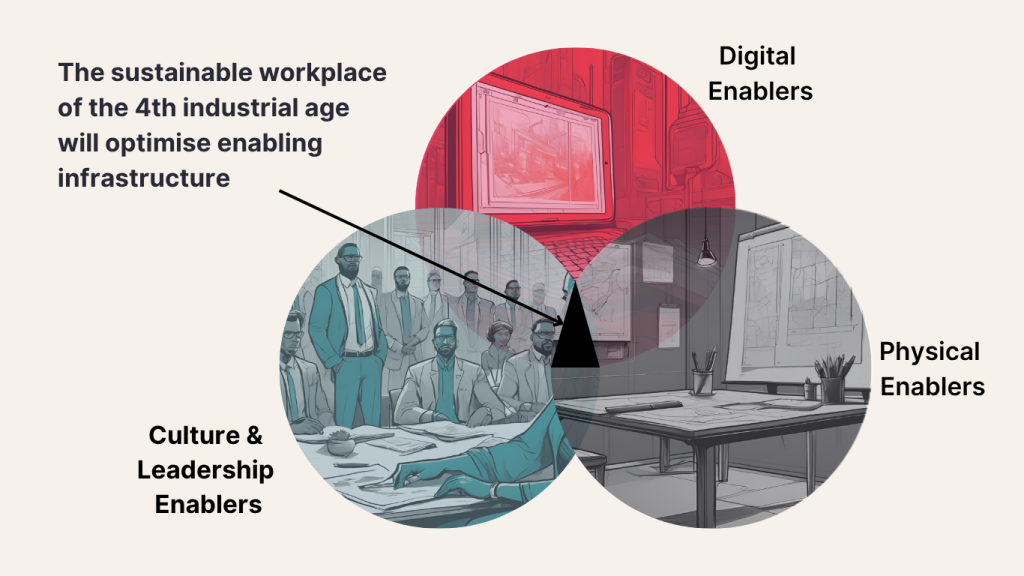
Instead of measuring increases in office productivity resulting from engagement-seeking perks, organisations should focus on supporting key cultural, digital, and physical performance enablers and critical success factors.

This will require joint recognition by human resources, real estate, and technology that the cultural, digital, and physical work environments are intertwined in employee perceptions of performance and satisfaction .

The results of the Phrasia and other research (such as  Leesman’s H-Lmi surveys),  highlights the interrelatedness of these workplace enablers and complexity of employee experience.

Cultural. digital and physical enablers of workstyles

Leaders must seek to optimise how these three dimensions interact to reinforce or undermine the entire performance environment.  They must also be more conscious about the risks of driving efficiency in one enabler – such as increase in desk sharing ratios – and undermining the effectiveness of another enabler – such as lack of investment in a booking and wayfinding app.   The optimal balance will be unique to every organisation (this is also a whole other subject, which I explored in my PhD thesis).


3. Expect autonomy and demand accountability

By regarding the workplace as a system comprised of cultural, digital and physical enablers, our team have been able to reframe the criteria for a “good” workplace experience that supports individual and team performance.  

We refer to this approach as  creating a personalised adaptive workplace system.  To transform knowledge worker performance, accept that you do not have all the answers and probably never will.   Instead consider the workplace to be a critical part of an adaptive system of physical, digital, and cultural performance enablers that your employees are empowered to leverage in different ways at different times to optimise their productivity.

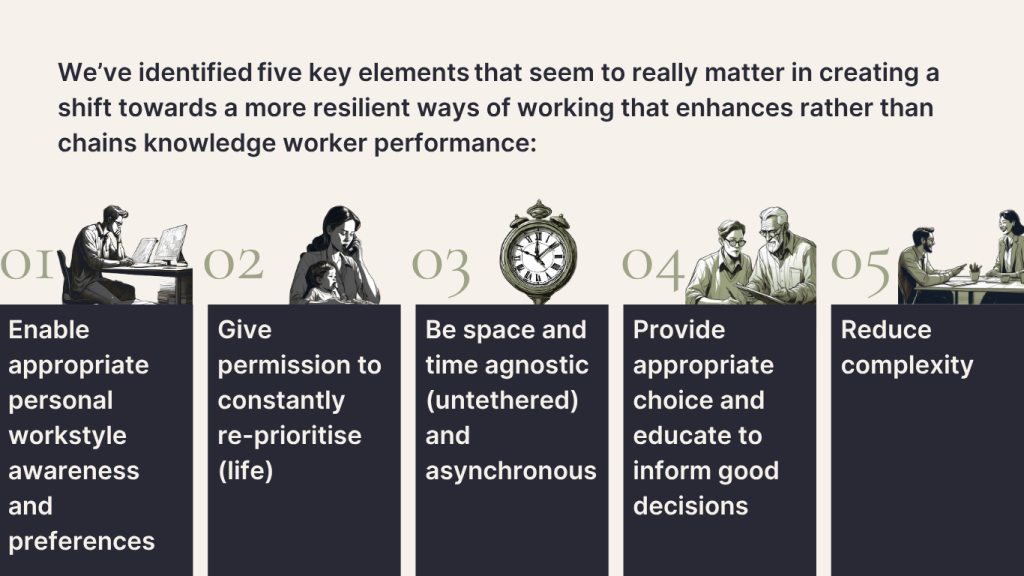
Five key elements that matter to enhanced knowledge worker performance
Five key elements that help transform office work into knowledge worker performance

4. Optimise the enabling infrastructure

Successful and sustainable organisations are built for destabilisation and organised for innovation and change.  

Recent years have revealed the  fragility of many of our organisational and institutional systems – built for efficiency rather than for adaptive performance – during periods of unprecedented geo-political, social or technological upheaval (including ‘black swan’ events), when assumptions and mental models become less useful, if not deceptive.

To achieve the resilience needed to respond to change, we must also be prepared for the “systematic abandonment of whatever is established.”  Our cities, communities, and our organisations are complex systems – and in that complexity lies both unpredictability and volatility but also agility and resilience.

The last five years of volatility and unpredictability have revealed the risks of engineering the **** out of organisational resources – people, process or property – in the pursuit of efficiency.   Smart boards and leaders have learned that efficiency tends undermine effectiveness and flexibility – what I call “wiggle room” to adjust, adapt and regenerate when circumstances render old paradigms obsolete.

Ask, experiment, learn, tweak, and monitor to constantly fine-tune the system and maintain its robustness.  Look for unforeseen consequences of workplace initiatives – both positive and negative – as this is where we often find  hidden opportunity and strategic value.

It is high time leaders started acting like the clock is running out.  Embrace the momentum of social and technological change to propel yourself and your people fully into the digital age by transforming office work into knowledge work.


If this feels worth exploring further, I’d welcome the conversation.

Caroline M Burns


Note

[i] Fast forward to 2026 and the flood of individual and enterprise applications that now incorporate some form of “AI” have yet to deliver significant productive or financial benefit, although company and industry specific cases exist, and leadership expectations remain high, especially in certain industries.  The transformational impact of AI on knowledge worker capabilities and workstyles also remains unknown at this stage.  Refer also to The Regenerative Edge editions: 6 Reasons Boards Must Integrate the AI Future of Work into Strategy and Integrating Generative AI to Amplify Human Potential in the Workplace.


Culture and DEI, Future of Work, Productivity and Value-Creation

The Future of Work APAC Conference – Chair’s Opening Session

 Title:

The Future of Work

Conference Chair: 

Dr Caroline Burns, Founder and Managing Director, Workplace Revolution

Event: 

APAC Future of Work Conference 2024

Date:

15-16 October 2024

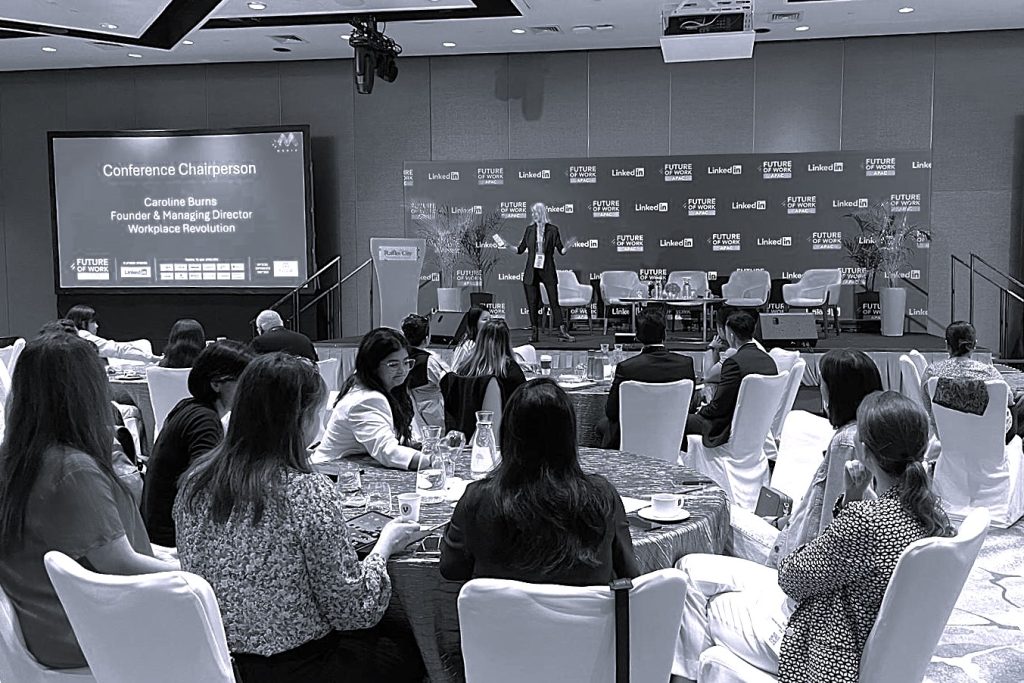
FoW APAC Chair 2024 audience

Chair’s opening session:

The world of work is at an inflection point.

Amid economic headwinds and tighter constraints, every leader I speak with is searching for ways to make their organisation more productive.

And as new technologies like Generative AI explode, it’s clear the global workstyle experiment that began in 2020 isn’t over—in fact, it may be just beginning.

This moment demands swift but smart action to set us on a path toward a better future of work.

But before going any further, I want to take you time-traveling to remind you how we got here, back more than 100 years to the industrial era when work was a rigidly structured activity, something linear and regimented.

And even as work evolved during the 20th century, when management guru Peter Drucker popularized the concept of “knowledge worker”, this mental model of work persisted.

Now in the post-smartphone, post covid era of digital-first work and artificial intelligence, work complexity has grown exponentially and innovative than at any time in history.

Knowledge workers are far more distributed and we’re able to work more flexibly than ever before.

In other words, work today looks very different than it did 100 years ago and even that it did 10 years ago—and so we must reevaluate what really drives productivity and how best to measure success as the future of work evolves.

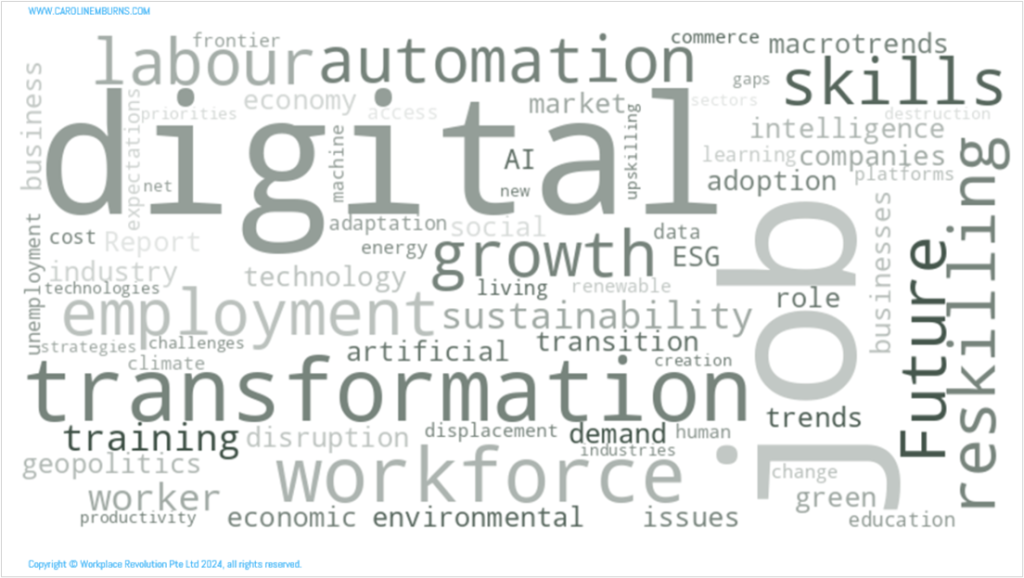
Future of Work word cloud

But what is the future of work?  Are we there yet?

Is it skills or capabilities or mindsets or an ability to learn and adapt?

Is it AI?

I believe the future of work is the stuff that makes us human.

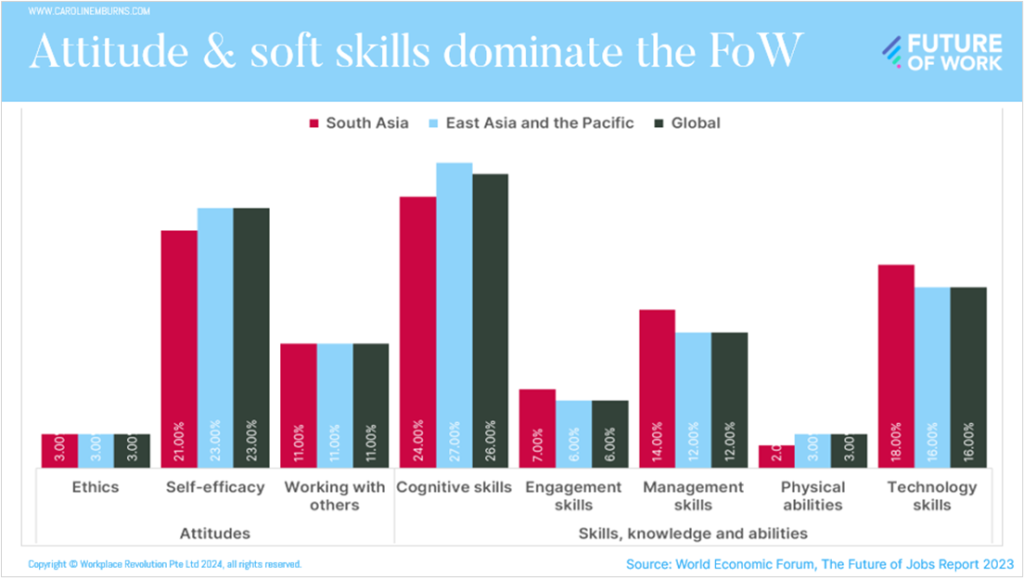
According to the World Economic Forum, cognitive skills including analytical thinking and creativity are most in-demand. Right behind these are 3 important attitudinal elements centred on self-efficacy, which is our confidence in being able to achieve a goal or complete something.

These are:

  1. resilience, flexibility and agility;
  2. motivation and self-awareness; and
  3. curiosity and lifelong learning

What we used to call “character”

World Economic Forum Future of Work global skills demand

But after more than a century of eliminating character and human messiness from work, we’ve forgotten how to do this.

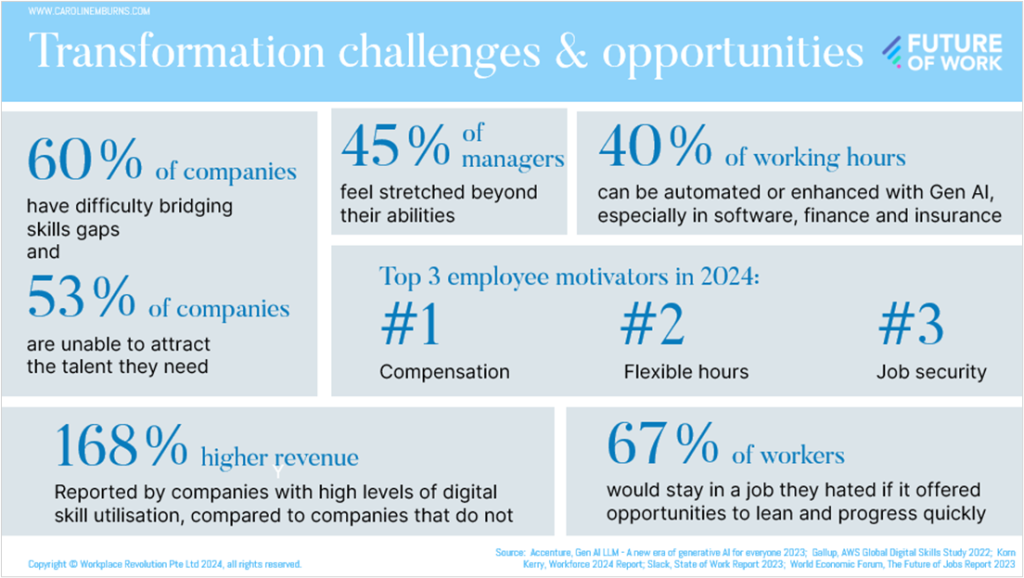
And that’s why we are here today.  Because more than half of global leaders say that skills gaps and difficulties attracting talent are the key barriers to transformation.

As influential leaders and experts, do we understand how these challenges affect the resilience and future success of our business?

….how to fill them?

…. and how long this might take?

Have we established and properly resourced a plan of action for the next year, 3 and 5 years?

Future of Work organisational progress metrics

These are the questions we are all asking ourselves.

And over the next 2 days our expert speakers and panellists will share their insights, experience and research to give you the edge in navigating the future of work.


More information on the conference agenda and delegates can be found here.

Future of Work, Productivity and Value-Creation

In Praise of Generous Leadership

As we embark on a new year, once again I find myself this first month reflecting on the year past and the year ahead – what am I looking to experience, learn and achieve, what do others around me need and how will I embrace ‘good’ leadership this year?

I keep coming back to a term I read many years ago in a management article – the term was ‘generous.’

And this really resonated with me because I felt I could be that way, that it came far more naturally to me than the ways I was supposed to be more of as a leader.

Generous leadership
In Praise of Generous Leadership

Being a hyper-shy person well into my teens who preferred books and adult conversation to groups of schoolmates, I have always been uncomfortable with leadership because it was supposed to be visionary, inspiring, assertive (I’ve always been opinionated but that’s not the same!), emotionally intuitive and persuasive.  Things I am not.

But placed in a leadership position I felt a responsibility to ‘be capable’ or at least be competent.  To do good rather than do harm.

So I decided to be generous with what I had instead of beating myself up over what I didn’t have or couldn’t be.

(Well I didn’t beat myself up too often, and still try not to!)

I can be generous with my time for my team, whether it’s to listen, to guide, to gently course-correct, to help prioritise, to understand their perspective, solicit their ideas, or just to get to know them better.

I can be generous with my knowledge, my strategic thinking, my rational approach to problem solving, my ability to quickly grasp new concepts, my deep experience and broad perspective earned through decades of consulting.

I can be generous with keeping confidences with clients and professional colleagues when they need a sounding board or sympathetic ear, some professional clarity or simply some free advice.

I can be generous with my trust and give you the opportunity to prove me right.

And I can be generous with myself, ensuring I sometimes check-in mentally or take heed of people around me who tell me to slow down, ease up on myself, say ‘no’ sometimes – because I can’t be generous when I’m burned out as there’s nothing left in the tank to give.  We can’t be good for those we lead if we can’t be good for ourselves.


After all, leadership is not a role—it’s a way of being.

Seventeen years ago when I founded a new regional business in Singapore under the ownership of an esteemed Australian firm, I had to build a team and develop a culture that took the best of our parent company, blended it with our multi-cultural context in Asia and made it unique through the people who joined us.

I knew inherently that being generous with my time would be the key to unlocking the full potential of my growing team.

When I was in the office I sat in the open plan with everyone else, chatted over morning coffee with the first-arrivers after me, ate lunch with them, personally onboarded every new employee and undertook all the performance evaluations (until at over 20 direct reports it was too many and we wisely reorganized reporting and coaching responsibilities!).

Despite a hectic travel and business development schedule I made a conscious effort to be present on the frontline, engaging with my team, learning from them (I wasn’t a technical professional) and listening to their suggestions and challenges.  I offered guidance and support whenever it was sought and did my best to foster an environment where everyone felt valued, respected and heard on an equivalent footing.

This generosity created a ripple effect within the team and became contagious, creating a workplace where everyone willingly supported each other.  People felt valued and supported, which allowed a family-like culture of community, commitment and creativity to flourish even under intense client pressure.  Ultimately, the success achieved wasn’t just in winning projects and meeting deadlines, but in building a team that thrived on mutual respect and shared accomplishments.


I’ve thought a lot about generosity as an important characteristic of leadership and I’ve come to realise that there are two other important elements.

One of these is Gratitude.

Gratitude may seem self-evident in these post-pandemic years, after all we heard a lot of heartbreaking stories of loss and resilience and hope.  Stories brimming with thankfulness for what people had rather than resentment for what they didn’t have.  Gratitude for the little things in life like the dancing shadows and the warmth cast by sunshine through a window, or the tenderness in a partners voice when they asked us, genuinely, how we were doing.

I also believe that a degree of gratitude can (or should) develop with maturity and experience and is a prerequisite for developing wisdom.

I have travelled independently through geographically and culturally remote parts of the world, moved to a city after university where I didn’t know a soul, moved to Asia to start a new business during the global financial crisis and started my own business more than once.  These experiences make the opportunities and advantages, of nature, nurture and context that I have had in life abundantly apparent.

I was challenged a number years ago by one of our youngest team members who would suddenly stop communicating and go silent on internal communication channels for days, letting agreed deadlines slip by.  This was immensely frustrating for the rest of our team and put us under pressure to ensure any client impact was minimal.  My initial reaction apart from frustration was anger at the apparent lack of responsibility when trust and autonomy had been given.  However, over the course of a number of very challenging meetings I made myself listen and try to understand before rushing to judgement.  I heard enough to decide that this was worth trying to work through together, but with strict boundaries, expectations, bi-weekly check-ins and a time limit of 3 months before a mutual stay-go decision.  I had a business to run after all!  I cannot be more pleased I took this course of action or more proud of this persons’ professional and personal development and commitment since this time.  Our relationship is deeper, more honest and much more rewarding than I could have hoped for, with the obvious benefits for our entire team and for the business.

As a leader, gratitude nudges me to be less demanding and more tolerant of my team and my colleagues, and to continue to be generous with my time, my attention, my experience and my expertise.

This is not a call for passive, albeit well-intentioned thankfulness for what we receive from others or the privileged upbringing we may have had.  Do not mistake grateful leadership with handholding or encouraging dependency.  While I am consciously grateful for the opportunities and gifts I’ve been given and the ‘good luck’ I’ve possibly had as well, it doesn’t mean I am any more tolerant of entitlement, self-pity, carelessness, laziness, disrespect or any other excuses not to do better and try harder.


Which brings me to the third important leadership characteristic I try to cultivate – graciousness.

On one occasion many years ago I was travelling with one of my team members and he mentioned to me how disappointed he was at being passed over for associate when a colleague of similar experience and time with the firm was awarded.  Despite having a tender due the next morning, I suggested we discuss how he felt after we had dinner with the local project team.  We found a quiet place in the hotel, and he shared his insecurities, his hopes and his family pressures.  We chatted well into the night.

Of course, I did not reverse the decision – because it was right – but I was sympathetic to the impact it would have on one of my dearest team members and wanted to ease this by reminding him how valuable he was to me, and the decision was not a reflection on his overall worth.  Through the conversation I helped him understand both the reason for my decision and what we had to focus on for him to be promoted the following year – which he very deservedly was.  His commitment during that year to professional growth and to taking on rather than avoiding challenges set an important example to the rest of our team.

Gracious is an old-fashioned word that to me embraces a ‘style’ almost, a way of being around and engaging with others.

A gracious leader is respectful but not reverent or necessarily obliging.  As a leader it’s important to have genuine compassion for your people while recognising your decisions may hurt, confuse or anger them at times.

A gracious leader does not avoid tough business decisions but is mindful of the impact on people, open and honest in communicating the need, and reasonable in efforts to ease unfortunate consequences.

A gracious leader is humble when appropriate but not falsely modest, like those who regularly expose minor shortcomings on social media, and then wrap them in the cloak of determination, discipline and achievement against adversity to inspire admiration (and likes) in their followers.

I will be honest with you, a small part of me would love to have tens of thousands of followers on LinkedIn, people who praise me for my hard-earned and highly deserved success, followers who turn me into an influencer and who feel inspired by the selfies and stories of my personal and professional wins.  In our need for instant gratification, it’s easy to confuse promiscuous posting and popularity with genuinely good leadership.

So I try to be a generous leader, to remember that generosity, gratitude and graciousness are ways of being that make me a better person but that are in the end not about me.

Being generous, grateful and gracious reflects in the small things we do and the decisions we make individually and collectively every day that in the long term help the people around me succeed and grow in whatever way is important for them.

Generous leadership builds trust and deepens relationships, gratitude develops open-mindedness, flexibility and resilience, and graciousness enables sound, strategic and mindful decision-making.


As leaders we are constantly making tradeoffs based on priorities, time and capacity.

When you look at a typical work week what priorities do you see reflected in your schedule?

How do you invest your time – ask yourself where are you truly generous and where might you be doing the minimum expected because there are so many other things to get done?

I challenge you to reflect on where you feel you should have been more generous in 2023, not because you missed out on immediate gratification but because you missed the opportunity to foster more sustainable and widespread benefits.

Could you have been more generous with your time with the people you lead, with your knowledge and expertise, with your openness to new perspectives and ideas, with your trust?  Or perhaps you need to be more generous with yourself first, so you can reflect this in your ways of being with others.

Choose one way in which you want to be a more generous leader in 2024 and consciously check yourself when you know you are holding back – and ask yourself why?  

Regularly reflect on the personal impact of being more generous by asking yourself how does this way of being make you feel?  And reflect on the impact on those around you – but don’t expect them to thank you outright.

Generosity is not a game of ‘if this then that’ and you are unlikely to see direct results in the short term, but it’s likely that over time you will become aware of the subtle ripple effects of your generosity, such as I have seen in engagement, commitment, personal development, retention and team performance.

Not to mention the personal reward of feeling that although I don’t have the traits of a natural born leader, I am at least competent and sometimes even quite capable. I think I do more good than harm.

Generous leadership is not weak, it’s positively powerful.


If this feels worth exploring further, I’d welcome the conversation.

Caroline M Burns


I would like to acknowledge some of the people who in ways large and small have contributed to my belief of what good leadership looks like, you.  Thank you for probably not even realising the effect you have had on those around you.

In alphabetical order (I could have done age or good looks but that would no doubt have caused an argument!):  Husodo Angkosubroto, Erwin Chong, Jackie Cupper, Simon French, Hong Siu Ming, Kate Langan, Patrick Marsh, Peter McCamley, Michelle Myer, Paul Rogers and Michael Zink.


This article was originally published in my newsletter The Regenerative Edge on January 25 2024.

Culture and DEI, Future-focused Leadership

Principles and Profits: ESG puts Ethics at the Helm in the Boardroom

The ice crystals crunch under my boots. The searingly blue sky lights up the ice sheet which is almost blinding to look at, even with decent sunnies on.  The glacial stream sparkles and dances its way through the ice and rubble, and I can hear water dripping.  It is 2019 and it is the sound of looming catastrophe[i].


I’ve had the amazing experience of journeying overland through some pretty remote parts of the world during the past twenty years, places that are environmentally and often also culturally fragile and threatened.  And while all of them, especially Tibet in 2004 and the Pamir/Wakhan/Hunza regions in Central Asia in 2012, were unforgettable and life changing, none had the visceral impact of my expeditions into the high Arctic in 2019 and again in 2022.

Greenland icecap August 2019
Walking on Greenland’s vast icecap which covers approximately 1.7M km2 (about 80% of the island – an area three times the size of Texas). The glacial streams are a result of rising Arctic temperatures causing the ice to melt. August 2019.

A few weeks after setting foot on the Greenland icecap, I was looking down from our chopper over the World Heritage Listed Ilulissat Glacier (also known as Jakobshavn Glacier).  I knew the gleaming iridescent streaked beauty I was privileged to see was well on the way to extinction, if not within my lifetime then certainly that of my niece, nephews and godchildren (technically now godadults!).  I have goosebumps even as I write this, at the almost inevitability of this tragic event that is symbolic of so much glacial melting, especially in the Arctic where warming is happening at a faster rate than anywhere else on the planet.

Illulissiat Glacier Greenland from the air 2019
Mouth of the Illulissiat Glacier Greenland from the air 2019

Fast forward to 2022, when I again traversed the Arctic, this time as well as Greenland also circumnavigating Svalbard.  This small archipelago, stranded on the roof of the world, is only 500 miles from the north pole (about the distance from Singapore to Kuala Lumpur or Atlanta to Raleigh in the US), and the northernmost permanently inhabited human settlement in the world.

And we haven’t done the place any favours – in a desolate, frozen landscape that is also teeming with birds, marine mammals, polar bears, arctic foxes, and reindeer, we have been whaling, sealing, game hunting and mining our way to wealth over past centuries.  If that wasn’t enough, the Barents Sea around Svalbard is warming up to seven times faster than the rest of the planet, according to a study published last year.

The Norwegian government are deeply committed to regenerating the ecosystems of Svalbard, including rewilding the last coal mine which closed this year.  But I was deeply shocked during a lecture by one of our expedition leaders, a marine scientist, who in response to a question on current whale populations replied that the last whales disappeared in the late eighteenth century and haven’t been back.  At all.  200 years ago you could literally cross a harbour in Van Keulenfjorden by walking on the backs of the whales.

Beluga whalebones Svalbard August 2022
Beluga whale bones bleached on a beach in Bamsebu on Spitsbergen Island, Svalbard. The heaps are estimated to contain the remains of 550 beluga whales which are designated as protected cultural remains that may not be touched or removed. August 2022

But I’m not sharing these experiences to change minds or stir hearts – other people far more qualified than me have devoted their lives to pursuing that mission.

What I am here for is to share my belief that Environment, Society and Governance (ESG) impacts are an ethical imperative for organisations and especially their boards, not just a compliance imperative.

And increasingly society, and much more slowly the capital markets, are recognising and rewarding ethical organisations.

Zodiac ride near Kangerlussuaq
Aboard a zodiac near Kangerlussuaq, West Greenland, August 2019.


What’s the Rush?

But how urgent is all this really?  Boards and Executives and the organisations they lead face unprecedented challenges including disruptive competitors, supply-chain issues, skills shortages and productivity challenges, digital transformation, and inflation.  In the face of these complex and often urgent issues, it’s easy to kick environmental and social impact way down the list of priorities, doing only what’s required to comply.  It can wait till next year, can’t it?

I’d suggest we look at this from a different perspective.  While executives must act on tactical issues or crises, a Board’s role is complementary and considers current challenges and emerging trends in the context of long-term performance and a broad cohort of stakeholders.  To quote Wong Su-Yen, immediate past Chair of the Singapore Institute of Directors,

“We are guardians of purpose and values, custodians of ethics, stewards of sustainable growth, and champions of resilience….In this evolving landscape, good governance safeguards the interests of all stakeholders, ensuring that organisations deliver value to all stakeholders and society at large.  It strengthens our institutions and enables us to thrive amid volatility.”

Glacier calving near Svalbard Aug 2022
Etonbreen glacier calving on Nordaustlandet, Svalbard. The glacier debouches into Wahlenbergfjorden. August 2022.


The Role of Markets and Regulators

Stock exchanges are crucial in facilitating capital allocation and driving economic growth.  During the past three to four decades markets and by extension listed companies have become increasingly short-term in outlook, favouring trading over investing.  The environmental and social impacts of corporate behaviour have not been valued appropriately, in part due to lack of disclosure requirements for environmental, social, and governance information.

However, there is growing recognition of the unsustainability of the current economic growth path in both social and environmental terms. Sustainability advocates and others have identified stock exchanges and evolving market structure as both contributors to the problem and a potential partner in the solutions[ii].  Exchanges and securities regulators are increasingly requiring ESD disclosure detail similar to financial disclosure requirements[iii].  However, even if optimised for sustainability, markets cannot solve our global ESG challenges, they can only reflect societal norms and expectations.

But at least things are moving in the right direction.


If You Can’t Measure It…

Exchanges also have an important role to play in developing sustainability indices, ratings and associated products that will guide investors to shift to more sustainable investment.

Earlier this month the Global Reporting Initiative (GRI) and the United Nations Sustainable Stock Exchanges (UN SSE) initiative launched a joint capacity-building program to better understand the practices and processes within member organisations and build technical skills within them to advance sustainability reporting requirements.

This last point is particularly relevant in my opinion.  Current sustainability reporting primarily focuses on climate change (mostly scope 1 emissions) and company risk potential. Future sustainability reporting will cover all ESG factors, considering their impact on the planet and society, opportunities, and risks, and enforcing business change from both external and internal perspectives[iv]. This is known as ‘double materiality’, as the impacts and risks between environment, society and organisations are multilateral.

Arctic flora Svalbard August 2022
The islands and fjords of the high Arctic are a kaleidoscope of seasonally changing landscapes, and surprisingly diverse when you get up close and personal – it’s not all rock, snow and ice! The flowers and lichens of autumn are especially beautiful.


Embracing Change to Reap the Rewards

The growing focus on ESG is leading change in the way companies operate, and by taking a regenerative approach to organisational ecosystems, boards and executives strengthen the ability to grow and adapt to change.

Organisations that “tick the box” risk missing the window of opportunity to see ESG as a force for positive change that can help the business become more sustainable, more resilient and in a better position to withstand the buffeting of a VUCA environment, as well as in the process improving performance and conformance across the board for multiple stakeholders, not just shareholders and investors.

Boards need to be ESG competent to stay ahead. Incorporating perspectives on environmental and societal impact, risks, and opportunities, especially medium to long term, is not just a ‘feel good’ exercise in stakeholder engagement, but an approach likely to deliver tangible benefit to the organisation. Discussions on strategy, risk, long-term value, corporate purpose and stakeholder expectations must include ESG considerations.

ESG information and data is used by external stakeholders to evaluate risk and make investment and business decisions.  Climate-related financial disclosures are included in the financial decision-making processes for 90% of disclosure users[v]  Because the information needs to be crediblealmost two-thirds of the world’s 250 largest companies by revenue obtain external assurance[vi].

A commitment to inside-out ESG principles has other material benefits.  The perception of a business’s ethical standards significantly impacts its reputation.  A positive reputation leads to lower costs, higher sales, and increased pricing power. Firms with a positive reputation have lower investment-cash flow sensitivity and can overcome credit constraints more easily.  Firms committed to ethics deliver twice the value to shareholders.

However, reputational damage impacts vary depending on the act or omission, and environmental and social misconduct are often perceived as less serious than financial misconduct.

ESD Disclosures, TFCD
Source Data: Task Force on Climate-related Financial Disclosures, “Summary of Implementation and Use Survey Results”, October 2022


Challenges Exist, but Should not Deter Ethical Compliance Efforts

ESG disclosure and reporting standards are evolving and there’s still a degree of inconsistency around the globe – it will be some years before this becomes BAU for listed companies and their stakeholders.

In the meantime, being aware of the likely challenges[vii] will help Boards and executives establish a staged plan of action that allows learning and internal capability to be built over time, and for stakeholder expectations to be managed.  In a recent survey, stakeholders identified the following challenges:

  • Governance (20% of respondents) – Mostly stemming from lack of expertise on climate-related issues within the board and senior management;
  • Strategy (51% of respondents) – Primarily related to selecting relevant scenarios and identifying key inputs and parameters in climate-related analysis;
  • Risk management issues (32%) – Challenges developing processes for identifying, assessing, and managing climate-related risks; and
  • Metrics (52%) – Collecting data across the value chain for estimating Scope 3 GHG emissions.
Mountain hike Spitzbergen Island
High above the beach on Spitsbergan Island, Svalbard after scrambling over a glacier and 800m up a rubble-strewn mountainside. The view over the fjord and glacier was worth it (until the clouds completely closed in!) August 2022.


One Foot in Front of the Other…

So, what steps can boards and executives take now to embed principles of good ESG into their strategic assessments, analyses, decisions, and reporting?

  1. Acknowledge that climate-related and increasingly comprehensive ESG disclosure is here to stay, regardless of personal beliefs and opinions.  Even if your company is not listed, it’s increasingly likely that your clients or customers, partners and suppliers will require this information from you as part of an increasing emphasis on scope 2 and 3 emissions disclosures.
  2. Develop a strategic vision for ESG that’s aligned with your brand, values and core business and embed this into corporate storytelling. This needs to be much more than a motherhood statement of warm and fuzzy commitment to saving the planet (or the polar bears for that matter!) There are plenty of resources available to guide you.
  3. Conduct a gap analysis and develop a specific action plan to ensure your organisation thoroughly integrates ESG considerations into overall governance, strategy, risk management and performance measurement and metrics.  This can be made more manageable and practical by breaking the critical gaps down into manageable components and distributing responsibility or tackling each component in sequence to build learning and know-how within the organisation.
  4. Commit to resourcing for small steps based on achievable goals and share quick wins internally and externally with key stakeholders. This will strengthen internal commitment and motivation for the long journey ahead.
  5. Regardless of the level of passion at Board level, passion will be needed for the long haul.  Harness and empower internal champions, encourage them to source ideas broadly within the organisation and to channel the best of these directly to the executive and board for consideration, and recognise and reward their achievements.
Board ESG Competency
Board ESG competency framework, adapted from Singapore Institute of Directors, 2023.


Focus on the Horizon

Once you’ve started the journey, if your organisation isn’t already modelling likely ESG-related risks, scenario modelling is an excellent way to improve and organisations’ ability to anticipate and prepare for material changes in the operating environment. 

I have successfully used scenario planning principles and select methods in the past to move executives beyond implicit assumptions of continuity, of tomorrow being much like today, of the future being a liner extrapolation of the present. This has helped me help my Clients develop more robust strategies and better understand acceptable versus preventable risks when assessing strategic options.

According to the Task Force for Climate-related Financial Disclosure (TFCD), scenario analysis helps companies consider how their climate-related risks and opportunities may evolve and their potential implications under different conditions.

Iceberg Scoresby Sund Aug 2022
Lonely iceberg, Scoresby Sund, East Greenland, August 2022.

While scenario analysis sounds complicated and does require preparatory research, it can be as simple as a whiteboard and post-it notes!  The foundations of a ‘good’ scenario model include:

  • Consultation and involvement of external stakeholders and independent subject-matter experts;
  • Generation of alternatives that may alter the basis for “business-as-usual” assumptions;
  • Exploration of the potential impact of those alternative operating conditions on the business;
  • A fleshed-out description of a potential path and key elements; and
  • A scenario that is plausible, distinctive, internally consistent, relevant and challenging.

Scenario analysis is useful for many types of long-range strategic planning where the context has high degrees of uncertainty, ambiguity, or volatility, i.e., not just environmental risks.


The “Why” in Sustainability

Business history is punctuated by the sudden collapses of major corporations such as Enron, Arthur Anderson, Lehman Bros, Worldcom, Blockbuster and Sears to name a few.  These organisations were respected for their successes and were assumed to be indestructible.

We risk assuming the same about our planet – after all, it’s survived millennia hasn’t it?  The question is not will our planet survive, but will it survive in such a way as to continue to allow human civilization to thrive on it?

ESG (Environmental, Social, and Governance) compliance represents a powerful relationship between business and environmental sustainability and establishes a foundation for regenerative potential to withstand future shocks and change.

Embracing ESG principles not only enhances a company’s reputation, access to capital, and stakeholder trust but also fosters sustainable practices that mitigate environmental harm, promote social equity and support cultural diversity.

I believe it’s important to act in the areas where you can make a difference – even if it seems small and somewhat futile – in your boardroom or backroom, your home, your community, your government, or your industry.

Gibbs Fjord glacier Aug2019
Glacier landing by zodiac, near Gibbs Fjord, Nunavit Territory, Canada. August 2019.

Workplace Revolution, the management consultancy I founded and lead, walks the talk in this regard – in 2022 we decided to aim for B-Corp certification and are currently completing the final verification phase.  Even for a modest firm it hasn’t been easy, some of the information was at our fingertips and some data from vendors across our distributed platform was impossible to source.  We were also surprised by the Clients that warranted a B-Lab follow-up investigation as it hadn’t occurred to us that those industries were a higher flag for poor ESG practices than ones you would assume were typically the ‘bad guys’.

We have learned a lot through this exercise, about ourselves and our extended network impact, where unfortunately we uncovered some ‘greenwashing’ where we had expected authenticity.  Regardless of outcome (although naturally we plan for the best!) the B-Corp certification process had a material impact on our reporting, our culture and our collective recognition of the importance of our eight core values in guiding our actions, in particular “Refer always to your sense of what’s right.”

Organisations that align business objectives with the imperative of environmental and social sustainability contribute to a virtuous cycle that benefits both their bottom line and the health of our planet and people, ultimately contributing to a more prosperous and less risky future for all.

And that’s bound to put a toothy smile on a walrus!

Male walrus colony Svalbard Aug 2022
Male walrus colony, Amsterdamøya Beach, Svalbard, August 2022


If this feels worth exploring further, I’d welcome the conversation.

Caroline M Burns


This article was originally published in my newsletter The Regenerative Edge on November 8, 2023.


Additional Notes and Sources

[i] On Tuesday 27 July 2021 Greenland’s vast icesheet that covers most of the country lost 8.5bn tons of surface mass – enough meltwater to drown the entire US state of Florida in 5cm of water in a single day. The region recorded an all-time record high temperature of 19.8C the next day. https://www.theguardian.com/environment/2021/jul/30/greenland-ice-sheet-florida-water-climate-crisis

[ii] UNEP “Stock Exchanges and Sustainability”, Inquiry Working Paper 15/13, December 2015.

[iii] The Singapore Stock Exchange joined the UN SSE initiative in 2016.
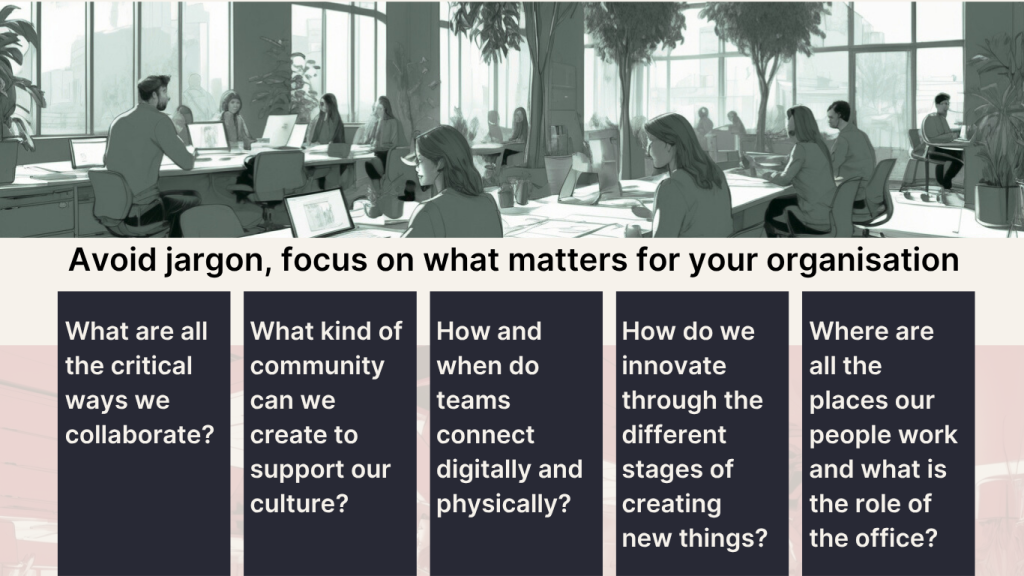
[iv] Singapore Institute of Directors Listed Entity Director (LED) Programme module “Environmental, Social and Governance Essentials”.

[v] Task Force on Climate-related Financial Disclosures, “Summary of Implementation and Use Survey Results”, October 2022.  The Task Force on Climate-Related Financial Disclosures (TCFD) was created in 2015 by the Financial Stability Board (FSB) to develop consistent climate-related financial risk disclosures for use by companies, banks, and investors in providing information to stakeholders.

[vi] Under SGX requirements, internal review is currently the baseline, but external assurance is encouraged to increase stakeholder confidence in reliability and accuracy of information disclosed.

[vii] Task Force on Climate-related Financial Disclosures, “Summary of Implementation and Use Survey Results”, October 2022.


Board Foresight, ESG, Future-focused Leadership

Get Comfortable with Uncertainty and Avoid Fear-motivated Decisions

The Aversion to Uncertainty

There is an aversion to uncertainty which means many leaders have a genuine fear of being wrong, and I see this more than ever with continued volatility and constant shifting of expectations and priorities in consumers and the workforce.   This fear of being wrong can be particularly evident in Asia, where corporate cultures tend to be more hierarchical and paternalistic, more conservative, and therefore more risk averse than those in ‘western’ business cultures.

I believe fear is driving many of the poorly communicated, backtracked, and ‘follow the leader’ decisions we see in response to changing market dynamics.

But what is wrong with wrong anyway?  

Right vs wrong decisions
Rethink what a ‘wrong’ decision might be.


‘Wrong’ is just a perspective on a situation – if you rearrange the letters, you are not ‘wrong’ instead you are ‘grown’

This simple acronym shows how easy it is to change the interpretation of an outcome completely, just by shifting our perspective on the labels we use.

Over the past decade management consultants have advised organisations to encourage ‘failing fast’, to experiment and course-correct and keep moving in response to a VUCA world.

But what we say is good for organisations unfortunately isn’t what tends to be expected of leaders – getting it wrong is a recipe for being shown the door, and that puts leaders in a very uncomfortable position.

In a world reshaped by unprecedented challenges, it’s time to reevaluate our traditional notions of leadership – are we asking too much, or perhaps not enough, from our leaders?  In this edition I unpack the shift in leadership dynamics over the past few years, suggest what it might mean to lead effectively in these transformative times, and highlight the risks to organisations of failing to adapt and respond to change.


The changing phases of leadership

I have witnessed a noticeable shift in leadership styles since the onset of the COVID-19 pandemic.  The worldwide lockdowns forced organisations to adapt swiftly to remote work arrangements, challenging deeply ingrained beliefs about the nature of work and leadership.  During this time employee and leader expectations have shifted through four phases:

  1. Trust and Unity amid Survival

The initial stages of the pandemic compelled leaders to foster trust and unity among their teams, driven by the collective need for survival. The crisis blurred the lines between hierarchical structures and emphasized the importance of problem-solving, communicating constantly and self-motivating.

  1. Calling out the “Can’t WFH” Myth

COVID-19 shattered the corporate line that many roles couldn’t be performed remotely more flexibly. Employees quickly realised that the reasons they had been given were mostly rubbish.

  1. Employee Empowerment

As businesses gradually recovered over the past two years, the balance of power shifted towards employees. The desire for remote work and better attention to wellbeing became more pronounced, driven by evolving employee expectations and the need for leaders to retain talent in a tight market as most sectors entered a rapid recovery period.

  1. Mandates and Changing Power Dynamics

However, recent global layoffs, particularly in industries such as technology and banking, coupled with rising inflation and financial uncertainty, have once again shifted the power pendulum. Leaders are leveraging this mood shift to assert their authority, for example the swing towards mandated days in the office.


The impact on employees

This shift in leadership styles has certainly not gone unnoticed by employees, and it has had several notable effects:

  1. Presenteeism vs. Performance

While employees may comply with mandates, the emphasis on physical presence can lead to presenteeism rather than improved performance. The focus on attendance can overshadow the importance of prioritising value-adding activities when in the office.

  1. Eroding Trust and Respect

Authoritative leadership erodes trust and respect within teams. It can create an environment reminiscent of school attendance, where individuals feel compelled to “show up” but may not be genuinely engaged or productive.

We know that disengaged employees are more likely to quit and that the main reasons for this are not feeling valued by the company or immediate manager.  McKinsey recently estimated that employee disengagement and attrition could cost a median-size S&P 500 company $228-$355 million a year in lost productivity, so there is significant risk when leadership actions create (whether intended or not) the perception that they don’t trust their people.

  1. Questioning Employee Autonomy

Command and control leadership styles implicitly assume that employees cannot make sound decisions for themselves and their teams. It undermines the belief that individuals, no matter how intelligent, can determine what’s best for their own performance and the company.

  1. Impact on Workplace Culture & Morale

Rather than driving desired behaviors and outcomes in the office, mandates tend to promote a checkbox mentality, which is already evidenced by the rise of ‘quiet quitters’.  Of course, there are underperformers and ‘slackers’ in every organisation, they existed before and during the pandemic and are still around.

However, taking a more authoritative approach to wielding power is akin to punishing the whole class because one child played truant at school – it didn’t work then, and it certainly doesn’t work in organisations now.

People managers need to be equipped with the skills and support from leaders to address mediocre performance directly, not through increased enforcement of rules and regulations for all.


What’s driving this type of leadership behaviour?

While I find mandates and authoritarian styles disappointing, I don’t underestimate how tough leadership is in the present era.  Before considering what leaders could do differently, I want to unpack a bit more of the motivation for current behaviour, because it’s kind of rational even if undesirable.

  1. Extreme Discomfort with Uncertainty

The world is far from settling into a ‘new normal’ – uncertainty, complexity and ambiguity are enormous challenges for leaders as actions have a considerable risk of unintended consequences.  Aversion to uncertainty is particularly evident in cultures that traditionally value hierarchy, paternalism, and risk aversion, such as those in Asia.

  1. The Fear of Being Wrong

Leaders understandably fear being wrong, which can lead to poor decisions or avoidance of decisions (a ‘do nothing’ approach which is in effect a decision not to act) and a reluctance to take the lead or be different from the mainstream.

According to the results of a recent global survey of more than 14,000 business leaders and employees by Oracle in partnership with bestselling author Seth Stephens-Davidowitz, a whopping 74% of business leaders said they’d held off on making a decision because they didn’t know what data to trust.  Leaders have more data than ever but in most organisations this data is increasing complexity not removing it – 86% of leaders said that they feel less confident making decisions and 72% admit it has stopped them from making any decisions at all.

This is a grave issue and while better data insights can help, its likely a false data prophet that claims to provide the solution to every decision dilemma, so it’s essential to challenge this fear of not being 100% right.

As leaders we must recognise that being wrong is not a failure but an opportunity for growth – not only for the leader personally but for sharing the journey and broadening ownership of the journey across the organisation.

Many organisations extoll the virtues of ‘failing fast’ but all too often leaders are held to different standards.


Steps towards improving leadership in an uncertain world

What practical steps can company directors and leaders take to transition towards a more encouraging leadership style that explicitly recognises the value of their employees and is consistent with the future of work capabilities leaders expect their people to demonstrate?

  1. Acknowledge the Need for Change

Recognise that old leadership models may not be sustainable in the current complex environment. Acknowledge the necessity of unlearning unhelpful mindsets and habits, even if it’s a challenging process.

This goes as much for independent board directors as well as executives.  While board directors may not be visible to employees, the board is ultimately responsible for setting the strategic direction of the organisation, adjusting as needed and supporting the top leadership team in the implementation of strategy.  At times this will require from leaders what might be viewed as courageous choices, changes of tack and acceptance of a degree of ambiguity, so leaders must know their Chair and Board understands this and has their back or they will not be effective in responding to change.

  1. Lead by Example

If you aspire to be, or are a leader today, you have a responsibility to lead by example and demonstrate the behaviours you expect from your people:

  • Take responsibility for your decisions and actions;
  • Balance your personal desires, anxieties, and expectations with those of your team and the wider organisation;
  • Communicate openly, proactively, and explicitly about your expectations – avoid ambiguity and obfuscation because your people are not stupid and will know when you are avoiding being honest about motivations and drivers.  According to Gallup only three in ten managers strongly agree their supervisor keeps them informed about what is going on within their organisation ; and
  • Be open to other perspectives and to negotiation within parameters or guardrails – if you acknowledge there isn’t a single ‘right way’ forward then it is much harder to be ‘wrong’!
  1. Support and Train People Managers

Managers form the bridge between leadership and the rest of the organization, which means they are often caught between employees’ and leaders’ expectations.  During 2023 there has been an acceleration in manager disengagement and burnout and a 10% uptick in those actively looking for a new job.  

According to recent Gallup surveys only 48% of managers strongly agree that they currently have the skills needed to be exceptional at their job and only three in ten hybrid managers have received any formal training on leading hybrid teams.

The manager makes all the difference for hybrid employees: having a great manager is four times more important than an individual’s work location when it comes to their engagement and wellbeing.

Provide customised coaching and training to help people managers navigate the complexities of leading hybrid and distributed teams.  Acknowledge that people managers should still be the first port of call when challenges arise, but instead of directing from above, encourage them to empower and support employees to find their own way forward.  The benefits of doing so were revealed in a recent Fortune article in which a company had replaced all its people managers with coaches , improving productivity by 20% (granted this is an extreme example I do not advocate!).

This has the added benefit of signaling to managers and their teams that they are trusted and gives leaders the confidence that within parameters teams will navigate the most effective way forward, increasing their ability to constantly respond to micro shifts in the operating environment.

  1. Harness Data Intelligence Intelligently

Most organisations don’t have a data problem, they have a “so what” problem.

According to the Oracle- Stephens-Davidowitz survey an overwhelming 91% of business leaders say the growing volume of data has limited the success of their organisation, and 77 % say that the dashboards and charts they get do not always relate directly to the decisions they need to make.

There are plenty of calls for the next generation of leaders to be equipped to understand and analyse data, at least at a higher level, and to use dashboard metrics and trend information to intelligently inform decisions.

This is a good start, but it doesn’t get to the crux of the problem – even the most advanced computing is not likely to predict with 100% certainty that a specific course of action or interpretation of why something is happening (not just what) will be right.  The accuracy of weather forecasts are a prime example of this.

In a VUCA environment we need human intelligence to review an optimised range of scenarios or predictions with a leaders’ understanding of the other levers that can be pulled to minimise risks or increase flexibility for a possible course of action.


We must become less uncomfortable with uncertainty and lead differently

The COVID-19 pandemic has highlighted the need for a fundamental shift in leadership styles.  Our world is increasingly confounded by ‘wicked’ problems that resist resolution.  Wicked problems usually have no single solution, so a human’s ability to acknowledge complexity and see our organisations and context as complex systems in constant motion rather than isolated data points can go a long way to developing change strategies that are less likely to fail.

This reality demands higher level capabilities from people in institutions and organisations operating all spheres of life – capabilities like critical thinking, problem solving, teamwork and greater degrees of self-management and responsibility.

These capabilities need a culture of trust and mutual respect to thrive – a culture that is completely undermined and revealed as hypocritical when leaders demand presenteeism rather than setting expectations for performance and letting smart, capable people decide how best to achieve that within their teams.

A culture that promotes trust and empowerment is essential for the success of modern organisations because this supports the development of critical skills and fosters a sense of responsibility among employees.

Leaders must become less uncomfortable with uncertainty because it’s a reality of business that is unlikely to change anytime soon.

Lead by example by demonstrating it’s ok not to have all the answers, it’s important to seek others’ advice and to be able to course correct as you go – this is essential for resilience and growth.

Boards, markets, and employees need to reevaluate our expectations of leaders to ensure we aren’t contributing to their dilemma by holding them accountable to an unintended double standard.


If this feels worth exploring further, I’d welcome the conversation.

Caroline M Burns


This article was originally published in my newsletter The Regenerative Edge on October 3 2023, and was inspired by a livecast interview I did a week prior, with Marcel Daane, MSc, PCC and Kilani Daane, NCC, ACC of Level V Partners on Leadership and the Future of Work. You can find the video of the interview here.

Board Foresight, Future-focused Leadership

The Future of Work and Leadership Interview

Title:

The Future of Work and Leadership Interview with Dr Caroline Burns

Presenters:

Dr Caroline Burns, Founder and Managing Director, Workplace Revolution

Kilani Daane, Executive Coach, Level V Partners

Marcel Daane, CEO and Principal Management Consultant, Level V Partners

Event:

Level V Partners Livestream

Date:

27 September 2023


About this interview:

Join us together with Dr. Caroline Burns in a very stimulating discussion about the future of work and leadership, and what will be needed from leaders in this ever-changing landscape. In particular we discuss:

  1. The shift we have seen in leadership styles post-COVID where leaders are taking on a more authoritative role rather than an encouraging role;
  2. How this shift in leadership styles has affected employees;
  3. What might be a more effective ideal leadership style in this post-pandemic world where many are facing new employee expectations, uncertainty with evolution, and news of layoffs;
  4. What steps leaders can take today to start moving towards this ideal leadership style; and
  5. Why it is important that leaders take the steps to learn to lead in a more encouraging rather than directive way.


Key takeaways

The fear of being ‘wrong’

I conclude the future of work and leadership interview by noting that although ‘return to office’ mandates are disappointing, I don’t underestimate how tough leadership is in the present era, and this behaviour is in many ways a rational if undesirable response to the environment.  Uncertainty, complexity and ambiguity are enormous challenges for leaders, there is a high risk of unintended consequences, and the aversion to uncertainty and ambiguity is particularly evident in Asia where corporate cultures tend to be more hierarchical and paternalistic, more conservative and more risk averse

So leaders have a genuine fear of being wrong.

I feel this fear is what’s driving poor or reversed decisions (such as return to office mandates) and “follow the leader” decisions, and it seems more so in Asia where many leaders don’t want to be first, and certainly don’t want to be perceived wrong.

But what is wrong with wrong anyway?

Wrong is just a perspective and a label if we mean what we say about failing fast, experimenting and course-correcting being critical capabilities in a VUCA world.

But what we say is good for organisations unfortunately isn’t what tends to be expected of leaders, getting it wrong is a recipe for being shown the door, and that puts leaders in a very uncomfortable position.

Future of work and leader capabilities

The future of work demands higher level capabilities from people – critical thinking, problem solving, teamwork and greater degrees of self-management and responsibility.  These capabilities need a culture of trust and mutual respect to thrive – a culture that is completely undermined and revealed as hypocritical when leaders demand presenteeism rather than setting expectations for performance and letting smart, capable people decide how best to achieve that within their teams

Leaders can take steps today to start moving towards a more ideal leadership style in the emerging environment by firstly acknowledging that old ways of leading are unlikely to be sustainable in our highly complex environment and that you might need help unlearning unhelpful mindsets and habits – which is really hard.

That being said, if you aspire to be or are a leader today, you have a responsibility to lead by example and demonstrate the behaviours you expect from your people:

  • Take responsibility for your actions
  • Balance your personal desires, anxieties and expectations with those of your team and the wider organisation
  • Communicate openly, proactively and explicitly about your expectations – avoid ambiguity and obfuscation – people are not stupid and will know when you are avoiding being honest about motivations and drivers
  • Be open to other perspectives and to negotiation within parameters/guardrails – if you acknowledge there isn’t a single “right way” then it’s much harder to be “wrong”

Secondly, as a leader you should help your people managers help their teams – customised coaching and training in managing hybrid/distributed teams is important in creating consistency across the organisation.  We ask (and assume) a lot from our overburdened, overstressed people managers and their relationships with their teams, and yet we know that managers are one of the key reasons people leave  – or join – organisations.

Invest in your own development and that of your managers as part of your future of work strategy – it’s not wrong to be wrong sometimes, but failure to recognise and act when change is needed (internally or externally) is a failure of good leadership in today’s post-covid VUCA environment.


This interview was published by Level V Partners and originally posted here.

Future of Work, Future-focused Leadership, Transformation and Technology

‘Hybrid’ Work – an Opportunity Missed?

Is the emergence of ‘hybrid’ work from the pandemic an opportunity missed for organisations and employees?

Covid showed us we can adapt, change and learn new things quickly:

New tools integrated into daily routines – VC meetings, Teams etc, cloud apps;

New workplace – home, but even more than before our laptop became our mobile, personalised office;

New level of self-determination, which felt powerful and equitable – to a degree we were more accountable for what we actually did, than what we looked like we were doing. Most people understood with trust came responsibility – to ourselves, our teams and ultimately our employer; and

New level of self-reliance, which felt good – “I can have all this thrown at me on top of my already overloaded stressy life, and I can survive, maybe I can even thrive some days”.

But not all that was new was good…Longer, more monotonous days at work, digital presenteeism and more meetings than ever (zoom-fatigue), isolation, the struggle for motivation and discipline, challenges with team communication and dynamics, and new stresses associated with maintaining boundaries between work and home.


So what did we learn, how did this shape our current perspective and priorities?

We learned not all work has to be done in an office.

We learned that our lives don’t necessarily have to revolve around our jobs.

We learned that we don’t have to have to put up with toxic workplaces or unreasonable expectations.

And above all, we learned the value of time – we can’t acquire more of it but we can use it more wisely to make our lives at home and at work more purposeful, fulfilling, healthy and balanced.

During lockdowns in 2020 we learned the value of our time

And in the process we have become less tolerant of things that seem to waste our valuable time – an unnecessary and crowded commute, expensive or limited food offerings, rushing to the gym in peak hour, waiting in a queue, overbooked and underused meeting rooms, hunting for a place to have a phone call, packing and unpacking our things, or being distracted by a nearby conversation.


What didn’t we learn or have forgotten?

As employees there seems to be a growing tension between responsibility and entitlement at work, a lack of understanding that work is a social contract that requires both parties to make specific commitments in return for specific (mostly financial) benefits (of course above and beyond these commitments are minimum ‘human rights’ for example around health and safety, dignity and discrimination).

The ‘Great Resignation’ (or ‘Reflection’) may partly reflect this tension, as we seek relief from the burden of having taken full responsibility for our health and wellbeing as well as our productivity, during lockdowns.

Perhaps this is simply a matter of the pendulum swinging the other way after decades of employers mostly calling the shots, particularly with the casualisation and globalisation of labour markets.

However the risk is we may fail to understand that the challenge of evolving and adapting to a new way of working is as much our responsibility as our employers. We may have missed the opportunity to leverage ‘hybrid’ work as a catalyst for real change.

The current tide of increasing employee expectations is contributing to the challenges leaders and managers face in navigating better ways of working that benefit everyone.

“It doesn’t make sense to hire smart people and then tell them what to do.”
Steve Jobs

But employers have also forgotten some of the learnings from lockdown; that most people will live up to your expectations if you trust them and provide support and guidance (or down to your expectations if you don’t), that trying and sometimes failing is a necessary part of learning, that employees often have a better idea than leaders of what works, and that people are human beings not human resources.

Managers forgot that people were often less productive in the office than they assumed
Managers forgot that people were often less productive in the office than they assumed.

Managers have forgotten that people were sometimes a lot less productive in the office than you assumed, and often a lot more productive at home than you expected.

Have we already have forgotten that the future will not be the same as the present? Have we missed the opportunity of hybrid to ready ourselves for the future of work?


Why haven’t more organisations used this experience to redesign work?

How many companies do you know conducted a “stop start continue” with their people on ways of working after the lockdowns ended? Sought insights and information that could help inform what the next steps and priorities should be in recalibrating how, when, and where work could be done?

Instead leaders and managers are focused on where people work and how many days they come into the office and who decides this, on providing employee experience apps or yoga classes, on upgrading digital communication and sharing tools, on harvesting cost savings from real estate portfolio reductions.

These are not inappropriate initiatives under the circumstances but they are less effective than they could be because assumptions and policies reinforcing twentieth century ways of working lurk in the room like a huge elephant.

Let’s talk about the elephant then.

“How can we expect to convince the best people to come work with us, if we reject anyone who needs the smallest bit of flexibility? How can we expect them to do their best work, but don’t trust them to know how to do so?”
AppleTogether.org

This global groupthink helps leaders regain the illusion that they have ‘a plan’ for success.

Regain the illusion of control over work.

Flexible work policies rapidly removed ambiguity by removing flexibility
Flexible work policies rapidly removed ambiguity by removing flexibility and employee choice

Work can be different, better. Workstyles must evolve.

“We see organisations addressing hybrid like it’s a problem and trying to solution for it. People have been working informally in a hybrid way for decades.”
Workplace Revolution Client during a Peer to Peer Roundtable

Industry 4.0 and an uncertain and complex environment demand adaptability, an open mindset and an unrelenting focus on converting knowledge into value.

‘Hybrid’ work has given us the ability to adapt and the awareness to recognise that change can be good.  Have we squandered this opportunity?

The physical, digital and cultural workplaces are blended more than ever into a singular experience of work. The lower- or slower-than-expected return to office rates for most organisations should be evidence enough that ‘where’ is less important to employees now than ‘why, how and when’.

‘Hybrid’ at its best is not a solution, it’s a shared understanding within an organisation or team about how to work well together – and all the little decisions every day that are part of that – to create value from knowledge. It’s being able (and allowed) to connect when and how it makes sense, with people who have relevant input, no matter where they are based.

It’s that simple.

And also that complicated if you try and control it from the top down.

Hybrid at its best is a shared understanding
Hybrid at its best is a shared understanding rather than a solution.


What more leaders should be doing

The covid pandemic delivered a massive shock to the system and showed us that what many thought was impossible was possible, and it’s obvious that the companies who thrived were generally already well advanced in developing their ‘future of work’ capability.

So it’s hard to understand why so many leaders avoid acknowledging the hypocrisy between the future of work mindset, skills and behaviours they want employees to bring to their role, while effectively asking them to leave this at the door and conform to outdated assumptions about what productive work looks like from the top.

What you can count on to deliver long term success are knowledge-generating capabilities like critical and lateral thinking, problem solving, decision-making, coaching, curiosity, collaborating across time and space, and a culture built on trust that rewards responsibility and initiative.

However the ‘Future of work’ is a journey not a current state for most organisations; these capabilities and mindsets take years to develop, so a fully flexible ‘free for all’ approach to workstyles is likely to fail as fast as a mandated ‘TWT’ policy.

Instead of just assuming that what works is what everyone else is doing, take a look not just at where work is done, but when and how in your organisation. Re-evaluate what good performance looks like, what capabilities and behaviours actually deliver long term value to your organisation.

Ask people what environmental conditions and experiences encourage those capabilities and behaviours, and what inhibit them?  Tools are available to help diagnose workstyles and identify gaps and potential interventions to optimise ways of working.

Look at when and how work is done, not just where

We’ve been given an opportunity to try things differently, to experience new things, learn new skills and build confidence in our ability to respond to significant change and uncertainty. It hasn’t been at all easy and many people and organisations have barely survived, but we have all learned something valuable.

We’ve been reminded that we can’t predict the future and we can’t remain in the past, but we can make the most of the present and not let opportunity pass us by.

We’ve learned time is too valuable to waste by ignoring the workstyle elephant in the room.

So, it’s time to invest in what you can count on – future of work capabilities and ways of working – rather than focusing just on what you can count – e.g. fewer offices, fewer people, more apps, more social spaces.

It’s time to invest in people before places, to redesign work before you redesign how different spaces and locations can best support that work.


If this feels worth exploring further, I’d welcome the conversation.

Caroline M Burns


If you enjoyed this article and would like to know more about the future of work and leadership, please watch the video of my live webcast interview on this topic with Level V Partners.

Flexible / Hybrid Work, Future-focused Leadership, People and Talent, Productivity and Value-Creation, Socio-Economic Trends

C is for Collaboration

The ABC’s of Workstyle

This is third in a short series attempting to decode hybrid workplace jargon to foster a more nuanced discussion on future work capabilities, workstyles and workplace in a post-pandemic world.  “C is for Collaboration” explains the importance of understanding the wide range of collaborative activities and specifically what valuable collaboration means for your people.


Collaboration is Not One Thing!

The “C word” was the inspiration for this decoding workplace jargon series, as ‘collaboration’ has been one of the most overused and misunderstood workplace terms in recent years!  I admit I am guilty of using it as well, and for a lot of people it’s a ‘catch-all’ word that encompasses a range of activities.  A recent HBR article[1] positing that we spend 85% of our time on collaboration drew a lot of critical online debate regarding what is defined as collaboration, with one colleague summing it up perfectly:

‘collaboration’ is organisational “loosey goosey language for any old interaction”[2].

However, it’s also become a highly obfuscating term for an enormous range of interactive activities we engage in as part of our work.  ‘Office for collaboration, home for focus’ has become the catchcry of post-pandemic workplace strategy.  This suggests it’s very similar across teams, organisations and cultures and can be addressed through a few sofas, team tables and ‘casual settings’ that look good on paper but often lack intent.

It suggests an intellectual laziness within business (expect blowback!) that we don’t sufficiently articulate the complexity of human interactions that are part of value-creating work.

If we cannot describe, how can we understand, if we cannot understand how can we design intentionally for these activities and behaviours?

What is Real Collaboration?

The Cambridge dictionary defines collaboration as “the situation of two or more people working together to create or achieve the same thing” 

The dictionary’s ‘SMART Vocabulary’ cloud shows almost 100 related words and phrases including accord, collectively, confluence, cooperative, gang, pairwork, teamwork, synergistic, tandem, together, unity.

I could go on, but the point is that by increasingly using ‘collaboration’ as a one size fits all term we ignore the myriad forms of interpersonal connections that create or achieve something together.

These may include (but not be limited to) collaborative activities such as mentoring and coaching, side by side teamwork, problem solving, decision-making, brainstorming/ideation, providing feedback, reviewing things together, co-creating things, interviewing, requirements gathering and briefing, ideating, voting/assessing alternatives, having a discussion or debate, planning together.  All these interactions have the potential to create or achieve something – which of these collaborations are most meaningful and important to you?

Key future of work activities for leaders and their teams

These interactions are not necessarily optimally or only done face to face in the office. Since the 1970s researchers who have studied physical proximity (the distance employees need to travel to engage in a face-to-face interaction) have disagreed on the question of whether it facilitates or inhibits collaboration[3].

The reality is that many collaborative activities migrate asynchronously from face to face to digital and back again or are a synchronous blend.

To quote a colleague who knows his collaboration data “think of your office as one big device that connects people. Just because people are not there doesn’t mean they can’t be connected.”[4]

However, in designing offices to support ‘collaboration’ the very different needs across the spectrum of interactions, activities, behaviours and mindsets are often overlooked.

For example, when we are coaching or giving feedback to a team member, how do we want to be positioned – face to face or side by side?  Do we want to be sitting or standing and how close together should we be?  How important is it for the receiver to feel psychologically safe so the feedback is truly absorbed?  Do we want a more formal or relaxed environment and will white noise help or hinder the flow of conversation?  What impact does the journey to this destination have on each person’s energy levels and mental state?

Optimise for Collaborative Diversity

As I suggested in the previous post in this series “B is for Behaviour”, we would do well to spend more time on work analysis to understand what collaboration means within an organisation.

Ask yourself, what types of interaction are most common and what are most valuable?  What don’t we support effectively now?

Take time to consider these questions in the context of the future of work capabilities and behaviours that are important to your business.  Think about how best to support these specific activities wherever they occur, allowing for the likelihood of synchronous face to face and digital interaction when planning the physical workplace settings.

This is not an argument against multi-use, flexible settings that can accommodate a range of activities, rather it’s a call to design those spaces within the broader context of a workplace that is optimised to support the rich diversity of collaborative activities that will create the most value in future.


If this feels worth exploring further, I’d welcome the conversation.

Caroline M Burns


References

[1] “Collaboration Overload Is Sinking Productivity” in Harvard Business Review, September 07 2021

[2] LinkedIn post comment by Geoff Marlow, 13 September 2021

[3] “Covid-19 has forced a radical shift in working habits” in The Economist, September 10 2020 edition

[4] “Interview with Cisco: Creating a digitally inclusive workplace” by Axiom, 2021

Flexible / Hybrid Work, Future of Work

Bkg Light Cream

D is for Desk-sharing

The ABC’s of Workstyle

This is a short series attempting to decode hybrid workstyle jargon to foster a more nuanced discussion on future work capabilities, workstyles and workplace.  Part 4 “D is for Desk-sharing” focuses on the need to focus on what workstyles and behaviours we want, rather than what type of desk-assignment we want.


There has been a lot of noise in the press in Singapore and Australia over the past 12 months about the dangers of desk-sharing, often referred to as ‘hotdesking’ or ‘activity-based working’ (ABW) – and this is before we further confuse the issue by talking about hybrid, remote, or telework.

My first concern with this dialogue in both the media and our industry is with the terminology.  It is outdated, inaccurate, open to misinterpretation, and hence skews the discussion of both positive and negative outcomes of a mobile workplace policy.

These labels hinder rather than help us have a constructive conversation about evolving workstyles and appropriate workplace design responses.

The Cambridge English Dictionary defines ‘hot-desking’ as “a way of saving office space in which workers do not have their own desk and are only given a desk when they need it.”   Wikipedia calls it an “office organisation system.”   Hmmm, sounds like an attractive employee value proposition doesn’t it?

‘Hotdesking’ is a Taylorist concept which emerged in the early nineties (a long time ago in office-years!), predominantly within sales companies and accounting firms who had significant numbers of staff working off-site for days or weeks at a time.

The term has little relevance to current practices involving some type of non-, or neighbourhood-assigned desking, supported by other shared spaces in the office, and off-site facilities in so called ‘third places’, at home or in satellite & co-working centres.

And I can’t get my head around the term ‘activity-based working’ – isn’t ALL work ‘activity-based’?

Google the term and you will find hundreds of references with little consensus as to what it really means, beyond generally supporting collaboration, choice and flexibility for employees.  I say this with absolute respect to Veldhoen + Company who claim to have invented the concept of ABW, and are justifiably recognised as a global leader in this field.  To their credit, Veldhoen promote ‘ABW’  as being much more than trendy interiors and open work areas, and ultimately about facilitating collaboration, engagement and innovation when properly designed and implemented.

D is for Desk-sharing
D is for Desk-sharing – avoid jargon and focus on what matters to your organisation

Whether desks are allocated to individuals or shared is not necessarily a mandatory requirement for ‘ABW’ (although it’s a fundamental premise of ‘hotdesking’).  You only need to look at the incredibly diverse environments created for companies such as Google, LinkedIn and Facebook – employers that eschew desk-sharing – to understand that these workplaces are specifically designed to promote collaboration, community, connection and innovation, all ostensibly goals of ‘ABW’.  Do these qualify as ‘activity-based’ environments or not?

My second concern with the discourse on ‘hotdesking’ and ‘ABW’ is that we don’t seem to have moved on from a fairly polarised discussion of the pros and cons, as if these would apply to any business trialling more mobile and flexible workstyles.  Given the number of organisations in Asia and Australia who have trod the ‘ABW’ path in recent years,

…we should have ample data as to what works and why, and what doesn’t work under certain circumstances.

So it’s disappointing to see that there is still a lot of emphasis on images of brightly coloured, hip interior spaces featuring artfully-placed collaborative furniture and cosy cafes, rather than a rhetoric-free assessment of an ‘activity based’ approach to workplace design that has been evolving for decades.

This concern has caused me to reflect on the successful evolution and implementation of BlueWork for American Express in Singapore in 2010, when I led the Asia region for a leading corporate workplace strategy and design firm.  At the time this project broke new ground within American Express globally.  It was also one of the first comprehensive ‘activity-based’ workplaces in Singapore, recognised by winning the International Property Award for Best Office Interior in 2011.

In an interview with IndesignLIVE the same year, I explained that while the design principles for the project are similar to most other ‘ABW’ workplaces in the region,

the strategy was deliberately aligned with the company’s culture, structure, workstyles and technology.

This people-led approach is evident in the key role human resources play with management in assessing employee workstyles and suitability, and in the commitment to pre-move training that guides employees and managers through the challenges that might accompany the transition.

This recount is not to suggest that this project was a best practice example of desk-sharing in a workplace. Instead, the takeaway here is that discussion of the pros and cons of desk-sharing, ‘ABW’, ‘hotdesking’ or ‘hybrid’ relies on misleading labels that may homogenise perceptions of workstyle policies and practices, rather than illuminate the diversity of contexts, applications and outcomes, in order to inform business and design choices.  


If this feels worth exploring further, I’d welcome the conversation.

Caroline M Burns

Flexible / Hybrid Work, Productivity and Value-Creation

B is for Behaviour

The ABC’s of Workstyle

A short series attempting to decode hybrid workplace jargon to foster a more nuanced discussion on future work capabilities, workstyles and workplace.  “B is for Behaviour” focuses on need for purposeful design to support value-adding Future of Work (FOW) behaviours and capabilities.


How vs Where Work Should be Performed

The first in this series of ‘The ABC’s of Work’ articles suggested that despite the high levels of trust bestowed between work colleagues and their leaders during the pandemic work from home years, the desire to control resources and people underpins much of the leadership thinking around future hybrid work strategy and reduces focus on purposeful design for future of work (FOW) behaviours.

Similarly, the desire to control, to work in way that feels familiar, suppresses the opportunity for organisations to engage in a conversation around how work could be performed in favour of going straight to where it should be performed.

‘Return to office’ often sounds alarmingly like a metaphor for return to how things were – office work that’s fundamentally little-changed in over a century but for the addition of email and smart phones in the last 20 years!

It seems to me that in too many cases workplace professionals are forging ahead redesigning offices for the way people have been working for decades based on the binary assumption that some activities will predominantly be done at home and others in the office.

We haven’t achieved what we have on this planet by going back in time.  Despite so much hype in mainstream management media about the ‘Future of Work’ (FOW) we seem to have missed the concept that FOW is happening now, every day, and if anything the need for FOW skills has been accelerated by the socio-economic responses to the pandemic.

We have an unexpected but timely window within which to redesign work activities and align behaviours with the emerging needs of the digital economy and of the incoming Generation Z workforce.

Re-design work not workplace for FOW behaviours

A focus on work styles rather than work places will help us understand the behaviours and experiences that contribute to performance.  The purpose of the future workplace  – and hence its design – will flow from what successful work looks like for an organisation and its people.

The World Economic Forum’s Future of Jobs Report lists many of the top capabilities that have been highlighted by researchers, institutions and management consultants for the past five years.

Eight key future of work capabilities

Instead of asking how many desks we need to support focus work and how many meeting rooms and informal ‘collaboration spaces’  we need for group activities,

let’s ask ourselves how we might purposefully compose and arrange different types of furniture, levels of enclosure, sightlines and pathways to support the development and expression of critical FOW behaviours.

I acknowledge this seems to be easier said than done!  New workplace projects are often under time and budget constraint, and there is understandably a strong temptation to skip business needs analysis and go straight to concept and furniture selection.  During a recent conversation with a colleague responsible for global workplace experience he shared an anecdote about a recent office refurbishment project-managed by an internal committee obsessed with design details rather than purpose.

Although the result was a “perfectly good looking design” the various settings and connector spaces lacked the ability to nudge behaviours intuitively in the desired direction.

We agreed that more effort needs to be directed towards developing a performance brief for the workplace to inform purposeful design for FOW behaviours.

Behaviour-driven design for purpose not for photography is even more important when office footprints are reducing.

Every square foot of space needs to justify its existence, its contribution to employee effectiveness and experience.

This requires us to precisely define the intended purpose of different spaces and settings, and translate this into a design that communicates its intent intuitively, without the need for instructions at the door or taped to the table.


If you would like to read more about the future of work and leadership please watch the video of my livecast interview with Level V Partners on this topic.

Culture and DEI, Flexible / Hybrid Work, Future-focused Leadership

A is for Agency

The ABC’s of Work

This is a short series attempting to decode hybrid workplace jargon to foster a more nuanced discussion on future work capabilities, workstyles and workplace.  Part 1 “A is for Agency” focuses on the choice vs control tug-of-war between employees and employers.


Choice and Control – or Choice vs Control?

I could also have called this “A is for Accountability” as its very related to my position on employee agency and access.  I first wrote about the socio-economic trends toward access to resources and services rather than ownership or control in 2017 in the final part of the series “Coworking – accessibility and agility is more important than control”.  I referred to the potential for workplaces to be provided ‘on demand’ through a mix of coworking, corporate and other places as part of a ‘work anywhere anytime’ portfolio approach to workstyles.

It’s great to see some Clients now seriously considering ‘hub and spoke’ (for want of a better word) strategies to better support portfolio agility, employee work-life blend and the environment.

However, what I find surprising is that despite the trust handed to employees during the pandemic lockdowns, many companies do not trust employees and their managers to make sensible, coordinated decisions about when to work from home and when to come into ‘the office’.  Scheduled “in-office” days undermine the ability of teams to self-manage.

The explosion in booking and rostering software platforms indicates to me that the desire to control is alive and well in many organisations, and that holding teams accountable for choosing to work in a way that enhances their performance is less palatable than dictating how many days people need to be in the office every week.

Employees seek control during uncertainty

There is also a significant element of employee desire for control – the uncertainty we live with every day and a natural human fear of ‘missing out’ drives behaviours such as presenteeism and block booking of meeting rooms and desks.

These are not post-pandemic behaviours but have been intensified by the profoundly personal lockdown experience.

New workstyle awareness fuels a desire for choice:

  • The lockdown experience 5 years ago has also given most people a new awareness of when they are most motivated, most creative, and most effective in their jobs.
  • Now is the time to harness this new-found workstyle-consciousness and demonstrate that as leaders we recognise and reward smart, responsible work choices.
  • Of course, there will be issues and office occupancy may be “lumpy” for a while, but I believe the benefits of reinforcing trust and extending agency and accountability to employees are significant.  What better way to allow high-functioning knowledge workers – the foundation of successful digital-era organisations – to perform and create value well beyond a mere job description?
  • Some of my Clients are considering just this approach, allowing people to come to the office when they need, use the spaces they want, connect with the colleagues they need to engage with, and hopefully have new experiences and interactions along the way.  They back this up with a range of utilisation data sources and analytics, a workplace governance process and engagement campaigns to share tips and best practices and gather feedback from people at all levels.  They have moved beyond workplace jargon to a deeper conversation around what choice and control should look like in their culture.

I appreciate this isn’t as easy as mandating rostered days in the office, but tight control gives a false sense of security.

This can end up causing more issues and requiring more direct management intervention than an office access policy of ‘agency and accountability’.


If this feels worth exploring further, I’d welcome the conversation.

Caroline M Burns

Culture and DEI, Flexible / Hybrid Work, Socio-Economic Trends

The Productivity Illusion

Office or Home?  Which is More Productive?

If you’re Jamie Dimon (CEO of JP Morgan), James Gorman (Chief Executive of Morgan Stanley), Tim Clark (CEO f Apple), Andy Jassey (incoming Amazon CEO) or a number of other prominent CEO’s, you firmly believe employees are most productive when they are in the office together[1].

However if you’re Ralph Hamers (CEO of UBS), Jack Dorsey (CEO of Twitter), Chuck Robbins (CEO of Cisco), Dean Tong (Head of Human Resources for UOB Bank) or others you firmly believe work from home can be as- or more productive than the office, and that work from home (WFH) has earned its place as a legitimate, permanent place of work for most employees some or most of the time.

Who is right?  Does it matter if the office or home is more productive, or is this an illusion?

I believe the more important questions are:

Are claims of more or less productivity even valid? What are leaders (or surveys) benchmarking supposed productivity changes against?  Are there comparable pre-covid measures?

Is ‘productivity’ a legitimate measure of the value of knowledge work, especially in the digital economy?

I’ll tackle each of these challenges and argue that is there was ever a time to throw off the century-old Taylorist paradigm that still dominates management thinking about office-based work, and embrace the need for people to be valued as knowledge workers – that time is now.


Are Claims of More or Less Productivity Valid?

Most of the ‘evidence’ on productivity during the enforced WFH periods is based on self-reported survey responses and I would bet that if you asked 10 or 10,000 people for a definition of work productivity you would get almost as many different responses.  So the reliability of these productivity statistics for decision-makers is flaky at best.

There’s also evidence to suggest that productivity is often conflated with hours of work – especially in Asia where long hours have generally been equated with productivity or employee value.  Longer hours of work during lockdown thus equals higher employee productivity (or so the theory goes).  Longer work hours during lockdown are probably due a combination of things: the natural result of not having to commute[2]; a desire to prove to managers who can’t see them that employees are “working”[3]; and to overcome the natural inefficiencies in remote communication and collaboration[4].

More hours of work doesn’t mean more effective outcomes; in fact while employees report the same or higher levels of productivity they report at the same time feelings of exhaustion, stress or other mental health challenges – especially in Asia and especially across Gen Z (those aged 18-25) where more than half are struggling to survive.  Compare this to leaders who appear to be thriving[5] and are often largely ignorant of the toll organisational expectations and personal anxieties are taking on their people.

The Productivity Illusion
The Productivity Illusion – time does not equal value.


What We Know about WFH Productivity

Hours of work aside, there is plenty of pre-pandemic research into the productivity of remote workers and the conditions most likely to support a successful remote work experience for the worker and the organisation[6] [7] [8] [9].  Regular remote work was becoming increasingly common within organisations of all sizes around the world before 2020, primarily fuelled by globalisation, enabled by the internet and digitisation, and driven by increasing demand from companies and workers for flexible and project-based work options.  The pandemic lit a firecracker under a trend that was already well-underway.

One relatively robust source of office worker productivity data is the Leesman Index™.  The responses from employees of Leesman corporate customers are self-reported measures so the interpretation of “productive” is somewhat open, however the comparisons of in-office responses (dating back a decade) to home-based responses in 2020 supports to many other claims regarding WFH productivity[10].

The Leesman comparison suggests that overall, WFH productivity depends on role (who are often the same, more senior people).  The results also support the widely-held belief that focus work, private/confidential calls and video/phone calls tend to be easier at home, and that learning from others, sharing ideas and informal social interaction and sense of community is better supported by time in the office.

No real surprises there.

People more productive working from home than office during lockdowns


Balance Long and Short Term Impacts

This and other studies on WFH productivity tend to focus on assessments of narrow, short-term outcomes and tightly specified task-based metrics.  The industry and academic research is relatively silent on longer-term effects and effects that are difficult to measure, such as innovation, employee retention, integration of new colleagues, and team cohesion.  If shifts to greater WFH affect social capital build-up (as there is some evidence to suggest[11]), the long term effects of hybrid work may be different to recent ‘crisis-mode’ experiences.

As a result, I think it is highly likely that leader decisions on where work should be done based on where employees are most productive are misinformed.

Such decisions are likely to be based on assessments of productivity that are highly subjective, not independently benchmarked against pre-covid productivity measures, and not measuring the stuff we do that really adds value.


Is ‘Productivity’ a Legitimate Measure of Knowledge Worker Performance – or an Illusion?

What’s not measured in survey results (and acknowledged by Leesman) are likely reduced levels of learning and growth through sharing and observing, individual expression and the “in-between” conversations before/after team-based activities.  This underlines the difficulty in quantifying the most valuable outcomes of high-performing knowledge workers.

Is the term ‘productivity’ as we generally use it relevant in the dialogue around the “Future of Work” in the digital economy?


Productivity in the Digital Economy is Not Easy to Measure

I would challenge most business leaders to describe how they measure productivity in their organisations.  Sure, its not too hard to measure certain metrics, for example sales per person or team, response times, processing times, error rates, assets under management etc., but many of these are ‘office worker tasks’ that computers do for us already and will probably completely automate within the next few years.

These metrics are ill-suited to assessing the messy, dynamic, interdependent way of working that is increasingly what the valuable knowledge workers in organisations do. The gradual decline of productivity (as measured by GDP per capita) in most developed nations since the 1960’s is another indicator of the difficulty of measuring productivity in an advanced knowledge economy[12].

It is also important to note that “if WFH simply shifts costs from employers onto workers whilst keeping the underlying ‘production function’ in terms of labour and capital inputs unchanged, it will have no direct effect on aggregate productivity [in the economy]”[13].

Reassess what performance looks like for knowledge workers
Reassess what performance looks like for knowledge workers.

Real productivity increases are only likely if organisations and society reassess what successful performance looks like for knowledge workers in the digital age, and re-tool ways of working to effect these improvements.


Interrogate Data for Performance-related Insights

Metrics on workstyle changes such as the number and duration of meetings, and changes in email and instant messaging traffic during the lockdowns provides some evidence of shifts in the way people are working as a result of increased WFH[14] [15].  However they are limited in helping us understand if these shifts are related to changes in employee effectiveness and business results.

The development and application of capabilities that contribute to corporate competitiveness like learning, problem solving, creativity, multi-disciplinary collaboration and empathy are not measured in terms of inputs but in long term, complex and often interactive effects.

The critical issue to consider in assessing home versus office is not productivity.  Measuring and managing by ‘productivity’ is a zero-sum game which as evidenced in survey after survey can obliterate the benefits of WFH and workstyle flexibility for many people.

Pay attention to performance eroders

Employees say the three biggest work-related challenges associated with remote work are maintaining company culture, maintaining team cohesion and coping with increased silos[16].  I believe the strain on team cohesion[17], company culture and collaboration is the slow fuse on the lockdown impacts.

The likely sustained impact of enforced WFH on a company’s ability to innovate may be less immediate and less observable than on ‘productivity’ but it should be gravely more worrying for leaders, who for the most part rank workplace innovation as their top transformation priority.[18].

Enforced WFH has forced many organisations to grudgingly admit people can be trusted to work responsibly when they are not in the office, although at the same time the rise in digital presenteeism and remote monitoring signals an erosion of trust[19].

While workers have shown remarkable resilience and adaptability through the crisis, there is significant room for improvement.

Many of the challenges presented by remote work are less of a technology problem and more of a people problem, primarily caused by carrying pre-pandemic culture and practices into a remote or hybrid way of working.

Companies have shown less ability to adapt than individuals in this regard but there are signs that many organisations have taken this opportunity (or been forced) to adapt processes, policies and management techniques to support employees through the lockdowns.


Focus on Fundamental Drivers of Sustainable Performance

If managers and leaders are able to continue this cultural shift in the way they manage and reward employees, then employees may not only be more engaged with their work but also more easily be able to solve problems, devise process improvements or suggest new ideas.  These are fundamental drivers of corporate adaptability and innovation.

More innovative and flexible workstyles are essential in the digital age

If the pandemic has taught us anything it should be that more innovative, flexible and independent ways of working are essential for survival in the digital economy. To move the needle, we need to reimagine many of the cultural practices that we’ve carried from the office into our homes.

I urge leaders to stop trying to decide if office or home is more productive and mandating how much time employees should spend in either location each week – it’s time to focus on new work solutions.

We have a unique opportunity to rethink how people can work rather than where they can (or should) work.
Let’s not waste it!


If this feels worth exploring further, I’d welcome the conversation.

Caroline M Burns


This article was originally published on LinkedIn on 30 July 2021.


Notes & References

[1] Based on public statements by these people or their company representatives at the time of writing.  This is not to say that these organisations have not acceded to employee pressure to allow some level of work from home, at least for a period of time.

[2] Barrero, Jose Maria and Bloom, Nicholas and Davis, Steven J., Why Working From Home Will Stick (April 22, 2021). University of Chicago, Becker Friedman Institute for Economics Working Paper No. 2020-174.  “Only one-fifth of this productivity gain will show up in conventional productivity measures, because they do not capture the time savings from less commuting.”

[3] https://www.bbc.com/worklife/article/20210604-why-presenteeism-always-wins-out-over-productivity

[4] Gibbs, Michael and Mengel, Friederike and Siemroth, Christoph, Work from Home & Productivity: Evidence from Personnel & Analytics Data on IT Professionals (May 6, 2021). University of Chicago, Becker Friedman Institute for Economics Working Paper No. 2021-56.   The research showed that Total hours worked increased by roughly 30%, including a rise of 18% in working after normal business hours; time spent on coordination activities and meetings increased, which meant that uninterrupted work hours shrank considerably; employees spent less time networking and received less coaching and 1:1 meetings with supervisors; and employees with children living at home increased hours worked more than those without children at home and suffered a bigger decline in productivity than those without children).

[5] “The Next Great Disruption is Hybrid Work – Are We Ready?” by Microsoft WorkLab in https://www.microsoft.com/en-us/worklab/work-trend-index/hybrid-work

[6] A. Maher & R. E. Bedawy, Core Practices for Managing Virtual Employees in Public Organizations. Journal of Business and Economics, 6 (2015) 113–120. https://doi.org/10.15341/jbe(2155-7950)/01.06.2015/011; and J. W. Gibson, C. W. Blackwell, P. Dominicis, & N. Demerath, Telecommuting in the 21st Century: Benefits, Issues, and a Leadership Model Which Will Work. Journal of Leadership Studies, 8 (2002) 75–86. https://doi.org/10.1177/107179190200800407.

[7] Diego Battiston & Jordi Blanes i Vidal & Tom Kirchmaier, 2017. “Is Distance Dead? Face-to-Face Communication and Productivity in Teams,” CEP Discussion Papers dp1473, Centre for Economic Performance, LSE.

[8] S. Kazekami, Mechanisms to improve labor productivity by performing telework. Telecommunications Policy, 44 (2020) 101868. https://doi.org/10.1016/j.telpol.2019.101868 .

[9] Unpacking the Role of a Telecommuter’s Job in Their Performance: Examining Job Complexity, Problem Solving, Interdependence, and Social Support. Timothy D. Golden and Ravi S. Gajendran, Journal of Business and Psychology, 1/2019.

[10] “The impact of home working on employee experience”, June 2020, Leesman.

[11] “Moving beyond remote: Workplace transformation in the wake of Covid-19”, results from the Remote Employee Experience Index commissioned by Slack, 2020.

[12] https://data.worldbank.org/indicator/NY.GDP.MKTP.KD.ZG?end=2020&start=1961&view=chart&year=1980

[13] “Covid-19 briefing: working from home and worker productivity” by John Lewis, Andrea Šiško and Misa Tanaka, Bank Underground (2021).

[14] https://hbr.org/2020/07/microsoft-analyzed-data-on-its-newly-remote-workforce

[15] https://www.economist.com/briefing/2020/09/12/covid-19-has-forced-a-radical-shift-in-working-habits

[16] “The Next Great Disruption is Hybrid Work – Are We Ready?” by Microsoft WorkLab in https://www.microsoft.com/en-us/worklab/work-trend-index/hybrid-work

[17] “Moving beyond remote: Workplace transformation in the wake of Covid-19”, results from the Remote Employee Experience Index commissioned by Slack, 2020.

[18] Building resilience & maintaining innovation in a hybrid world”, report by Microsoft Corporation, 2020.

[19] Mortensen, M Gardner, H (2021) WFH Is Corroding Our Trust in Each Other. Harvard Business Review. https://hbr.org/2021/02/wfh-is-corroding-our-trust-in-each-other

Board Foresight, Future of Work, Productivity and Value-Creation, Socio-Economic Trends

Why a Google Office Won’t Work for You

Copycat offices don’t work any more than copycat cultures do!

The open plan office versus closed debate rages on, and rather than running out of steam in the face of evidence and reasoned argument by many industry thought-leaders, it seems to have nine lives!  Tech company offices seem to be particularly popular examples of why highly open and transparent workplaces do, or don’t work, especially headline-grabbing Google.

This public debate has led to some very interesting and insightful discussions in various forums (to which I have contributed), inspiring me to synthesise the key themes into 4 reasons why a ‘Google office’ is not necessarily the right office for your organisation.

Four reasons a Google office wont work for you
Four reasons a Google office may not be the best choice for your people


1. The “Open Plan versus Enclosed” Debate is the Wrong Discussion

Firstly, I am not alone in saying that the fundamental basis of the debate, i.e. ‘open plan versus offices’, is misconceived.

The best performing workplaces are balanced.

They are tuned to the unique mix of roles and types of people in an organisation, providing adequate access to places for collaboration, for focused work and for more routine teamwork.  An open plan office without enough of these spaces will undermine productivity, and result in tension and frustration among employees.  Google’s office space (and many other companies) get this right for their unique combination of employee demographic, job functions and culture.

While the author of one article against open plan sees working from home as a potential solution, this option is not practical in many cities (especially in developing countries) or for many personal situations, although it can be an important element of flexible work programs.  A holistic approach is needed that aligns in- and out-of-office options to provide as much flexibility and choice for as many people as possible, aligned with company values.


2. How You Implement the Change has a Massive Impact on Employee Perceptions

The second major element that is often overlooked in ‘against’ articles is that how you implement a new way of working is almost (or even equally!) as important to a successful employee outcome as what design you implement.  This is another reason why copycat offices are unlikely to work for your people.

Many arguments against open plan appear to be understandably fueled by the frustration and resentment resulting from having been ‘forced’ into an open plan environment by their employer (usually after what is perceived as many productive and happy years working in a private office).

People generally don’t like major change, and when they are not engaged, educated and empowered during and after the transition to a more open environment, the resentment is palpable.

Companies with visionary leadership that help employees understand how and why their workplace supports individuals, teams and the company as a whole to achieve their goals, are generally far more likely to have productive and engaged employees in new environments.

A robust engagement and change strategy doesn’t hurt either – unfortunately many programs are less successful than they should be, primarily due to lack of said point above – visionary leadership!  Google employees know what they are signing up for when they join, and as Google evolves as an organisation, their workplaces are slowly evolving (and learning from employee feedback) to keep pace.


3. The Workplace is Only as Good as the Behaviours of the People Using It

Thirdly, any workplace design is only as effective as the behaviour of the people who occupy it – loud conversations, ‘camping’ in quiet rooms, using speakerphones and ignoring signs that a colleague needs to focus are all symptoms of a lack of etiquette-setting or enforcement.

Many workplace ‘problems’ are cultural, managerial or technological, and need to be recognised and addressed as such.


4. Context Matters – If You Don’t Work for Google, a Google Office Probably Won’t Work for You!

Context is everything; unfortunately too often the media conveniently forget this and prefer attention-seeking headlines and inappropriate use of terms such as ‘hotdesking’ which serves to confuse the argument even further.

How a workplace looks, its’ trendy design and cool breakout spaces are only the visible (but still important) tip of the iceberg for having happy and productive employees.
How a workplace looks, its’ trendy design and cool breakout spaces are only the visible (but still important) tip of the iceberg for having happy and productive employees.  There’s a lot more to consider!

What works for Google’s offices probably won’t work for your organisation.  You probably have a different culture, brand, services or products, values, employee demographics, locations, leaders, customers, challenges, technology enablers…you get the drift.

Don’t forget also that Google is a diversified and evolving organisation and so its’ office designs are tailored to the country and culture, functions (for example sales versus engineering) and local business needs, and are constantly recalibrated based on feedback and learning’s. Google gets it rightfor Google.

Be inspired yes, but not blinded by others organisations’ successful workplaces.

If only it was as simple as open plan versus enclosed, but its not.

Be smart and dig into why the space works for them (and what doesn’t work) – are there parallels to your organisation, or too many differences? Organisations and people are unique, dynamic, complex and reactive – your new office needs to be the same.


If this feels worth exploring further, I’d welcome the conversation.

Caroline M Burns


This article was published by Workplace Insight Magazine in February 2016 as “Why a Google office simply doesn’t work for everybody”

Many thanks in particular to David Rostie and Kay Sargent for their valuable online contributions to the debates which inspired this article!

Culture and DEI, Productivity and Value-Creation