
Read Time: 11 minutes
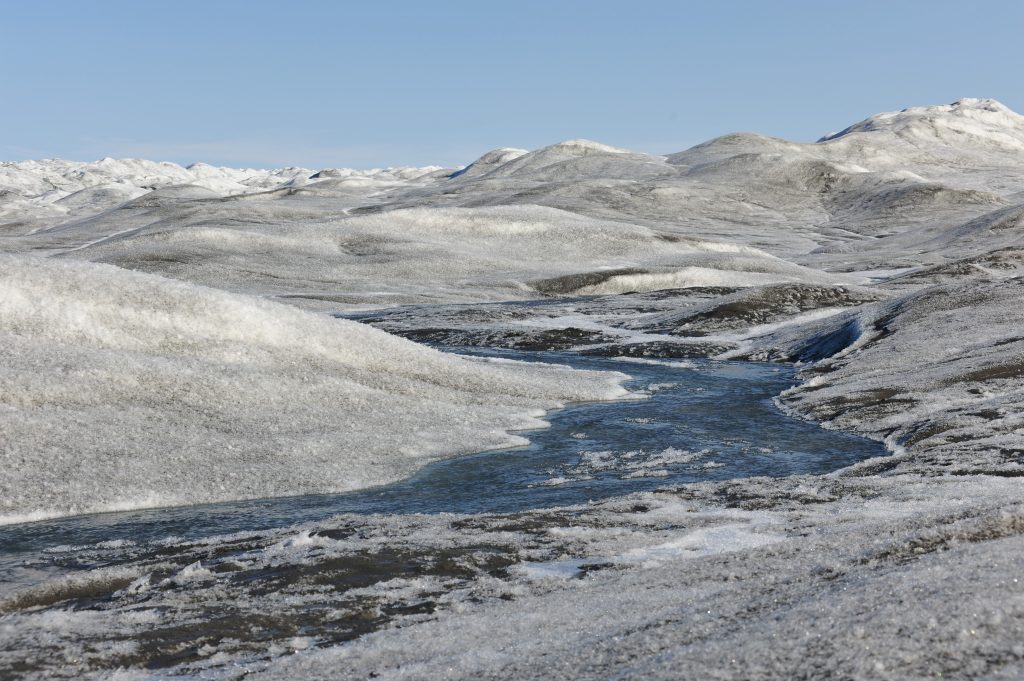
The ice crystals crunch under my boots. The searingly blue sky lights up the ice sheet which is almost blinding to look at, even with decent sunnies on. The glacial stream sparkles and dances its way through the ice and rubble, and I can hear water dripping. It is 2019 and it is the sound of looming catastrophe[i].
I’ve had the amazing experience of journeying overland through some pretty remote parts of the world during the past twenty years, places that are environmentally and often also culturally fragile and threatened. And while all of them, especially Tibet in 2004 and the Pamir/Wakhan/Hunza regions in Central Asia in 2012, were unforgettable and life changing, none had the visceral impact of my expeditions into the high Arctic in 2019 and again in 2022.
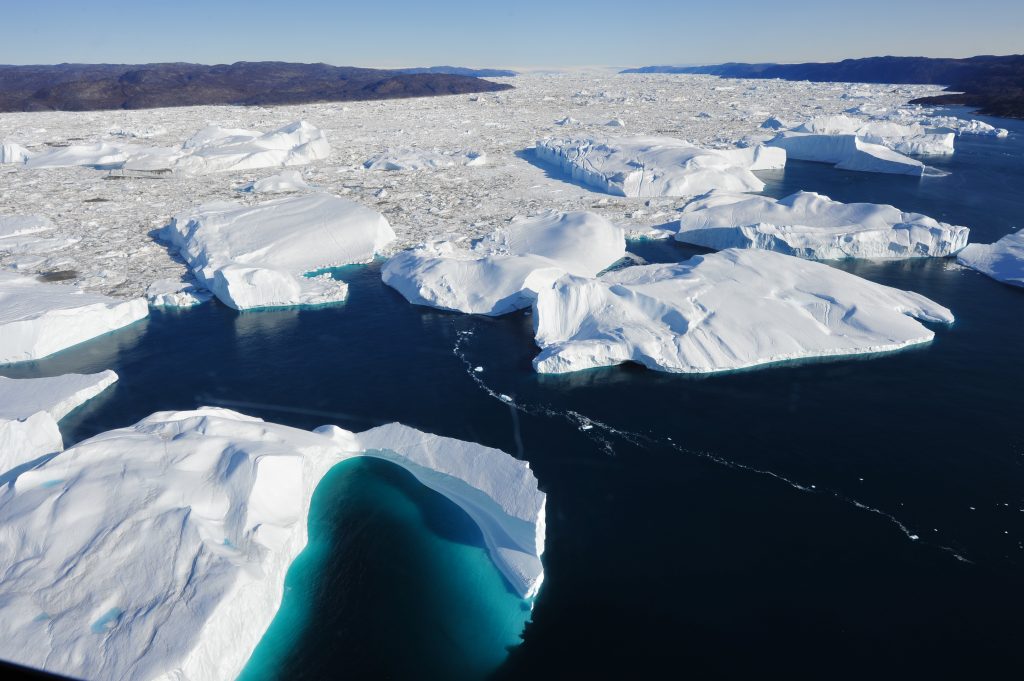
A few weeks after setting foot on the Greenland icecap, I was looking down from our chopper over the World Heritage Listed Ilulissat Glacier (also known as Jakobshavn Glacier). I knew the gleaming iridescent streaked beauty I was privileged to see was well on the way to extinction, if not within my lifetime then certainly that of my niece, nephews and godchildren (technically now godadults!). I have goosebumps even as I write this, at the almost inevitability of this tragic event that is symbolic of so much glacial melting, especially in the Arctic where warming is happening at a faster rate than anywhere else on the planet.
Fast forward to 2022, when I again traversed the Arctic, this time as well as Greenland also circumnavigating Svalbard. This small archipelago, stranded on the roof of the world, is only 500 miles from the north pole (about the distance from Singapore to Kuala Lumpur or Atlanta to Raleigh in the US), and the northernmost permanently inhabited human settlement in the world.
And we haven’t done the place any favours – in a desolate, frozen landscape that is also teeming with birds, marine mammals, polar bears, arctic foxes, and reindeer, we have been whaling, sealing, game hunting and mining our way to wealth over past centuries. If that wasn’t enough, the Barents Sea around Svalbard is warming up to seven times faster than the rest of the planet, according to a study published last year.
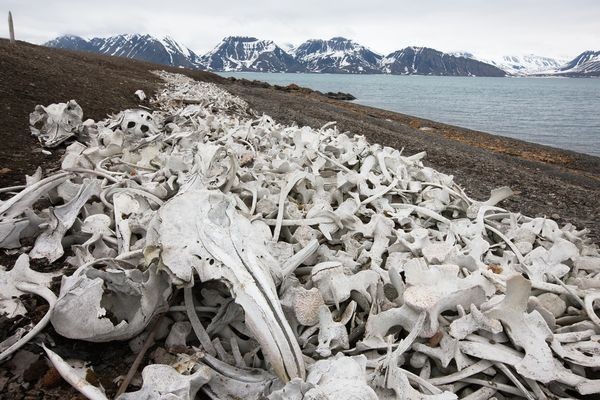
The Norwegian government are deeply committed to regenerating the ecosystems of Svalbard, including rewilding the last coal mine which closed this year. But I was deeply shocked during a lecture by one of our expedition leaders, a marine scientist, who in response to a question on current whale populations replied that the last whales disappeared in the late eighteenth century and haven’t been back. At all. 200 years ago you could literally cross a harbour in Van Keulenfjorden by walking on the backs of the whales.
But I’m not sharing these experiences to change minds or stir hearts – other people far more qualified than me have devoted their lives to pursuing that mission.
What I am here for is to share my belief that Environment, Society and Governance (ESG) impacts are an ethical imperative for organisations and especially their boards, not just a compliance imperative.
And increasingly society, and much more slowly the capital markets, are recognising and rewarding ethical organisations.
What’s the Rush?
But how urgent is all this really? Boards and Executives and the organisations they lead face unprecedented challenges including disruptive competitors, supply-chain issues, skills shortages and productivity challenges, digital transformation, and inflation. In the face of these complex and often urgent issues, it’s easy to kick environmental and social impact way down the list of priorities, doing only what’s required to comply. It can wait till next year, can’t it?
I’d suggest we look at this from a different perspective. While executives must act on tactical issues or crises, a Board’s role is complementary and considers current challenges and emerging trends in the context of long-term performance and a broad cohort of stakeholders. To quote Wong Su-Yen, immediate past Chair of the Singapore Institute of Directors,
“We are guardians of purpose and values, custodians of ethics, stewards of sustainable growth, and champions of resilience….In this evolving landscape, good governance safeguards the interests of all stakeholders, ensuring that organisations deliver value to all stakeholders and society at large. It strengthens our institutions and enables us to thrive amid volatility.”

The Role of Markets and Regulators
Stock exchanges are crucial in facilitating capital allocation and driving economic growth. During the past three to four decades markets and by extension listed companies have become increasingly short-term in outlook, favouring trading over investing. The environmental and social impacts of corporate behaviour have not been valued appropriately, in part due to lack of disclosure requirements for environmental, social, and governance information.
However, there is growing recognition of the unsustainability of the current economic growth path in both social and environmental terms. Sustainability advocates and others have identified stock exchanges and evolving market structure as both contributors to the problem and a potential partner in the solutions[ii]. Exchanges and securities regulators are increasingly requiring ESD disclosure detail similar to financial disclosure requirements[iii]. However, even if optimised for sustainability, markets cannot solve our global ESG challenges, they can only reflect societal norms and expectations.
But at least things are moving in the right direction.
If You Can’t Measure It…
Exchanges also have an important role to play in developing sustainability indices, ratings and associated products that will guide investors to shift to more sustainable investment.
Earlier this month the Global Reporting Initiative (GRI) and the United Nations Sustainable Stock Exchanges (UN SSE) initiative launched a joint capacity-building program to better understand the practices and processes within member organisations and build technical skills within them to advance sustainability reporting requirements.
This last point is particularly relevant in my opinion. Current sustainability reporting primarily focuses on climate change (mostly scope 1 emissions) and company risk potential. Future sustainability reporting will cover all ESG factors, considering their impact on the planet and society, opportunities, and risks, and enforcing business change from both external and internal perspectives[iv]. This is known as ‘double materiality’, as the impacts and risks between environment, society and organisations are multilateral.

Embracing Change to Reap the Rewards
The growing focus on ESG is leading change in the way companies operate, and by taking a regenerative approach to organisational ecosystems, boards and executives strengthen the ability to grow and adapt to change.
Organisations that “tick the box” risk missing the window of opportunity to see ESG as a force for positive change that can help the business become more sustainable, more resilient and in a better position to withstand the buffeting of a VUCA environment, as well as in the process improving performance and conformance across the board for multiple stakeholders, not just shareholders and investors.
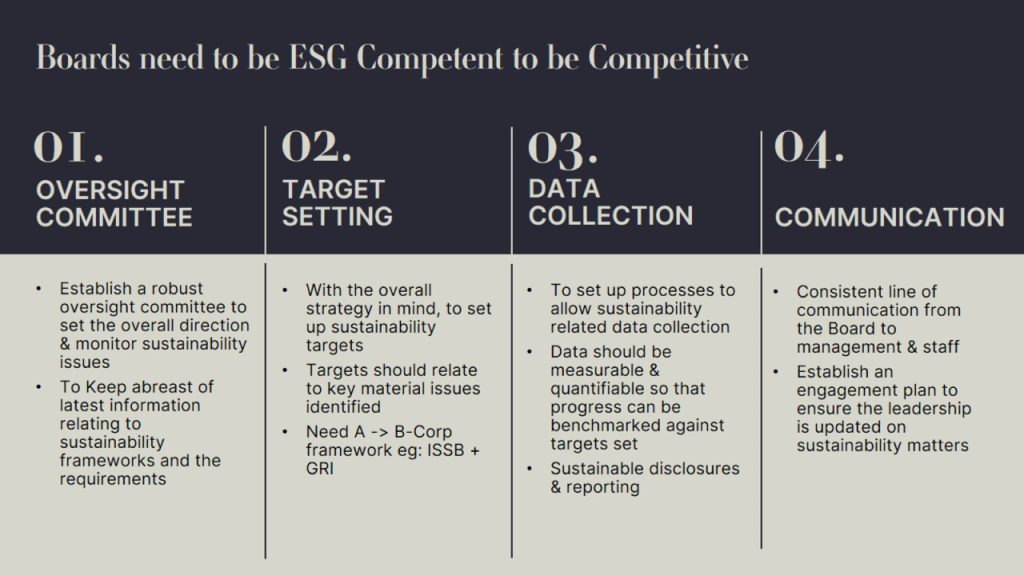
Boards need to be ESG competent to stay ahead. Incorporating perspectives on environmental and societal impact, risks, and opportunities, especially medium to long term, is not just a ‘feel good’ exercise in stakeholder engagement, but an approach likely to deliver tangible benefit to the organisation. Discussions on strategy, risk, long-term value, corporate purpose and stakeholder expectations must include ESG considerations.
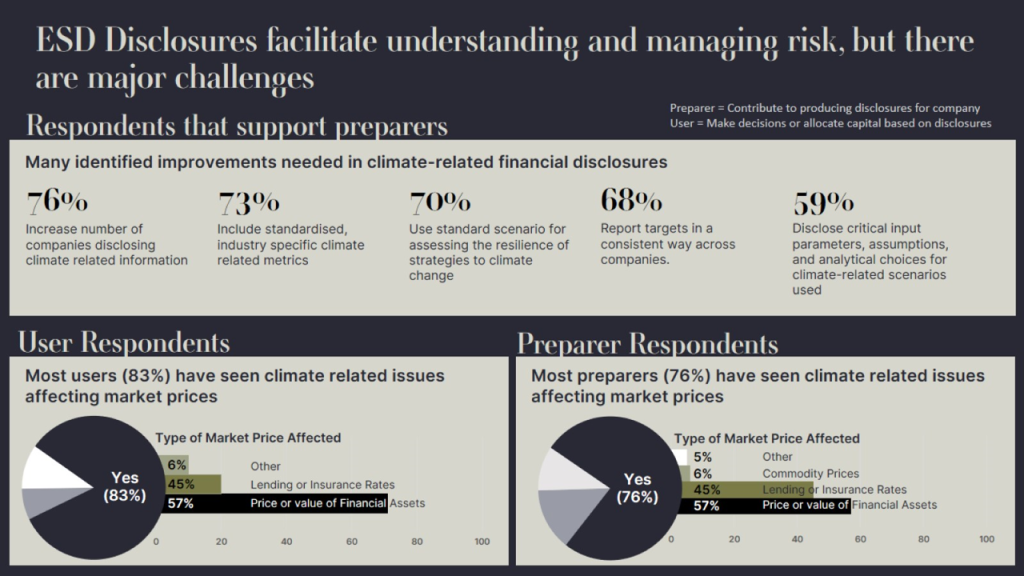
ESG information and data is used by external stakeholders to evaluate risk and make investment and business decisions. Climate-related financial disclosures are included in the financial decision-making processes for 90% of disclosure users[v] Because the information needs to be credible, almost two-thirds of the world’s 250 largest companies by revenue obtain external assurance[vi].
A commitment to inside-out ESG principles has other material benefits. The perception of a business’s ethical standards significantly impacts its reputation. A positive reputation leads to lower costs, higher sales, and increased pricing power. Firms with a positive reputation have lower investment-cash flow sensitivity and can overcome credit constraints more easily. Firms committed to ethics deliver twice the value to shareholders.
However, reputational damage impacts vary depending on the act or omission, and environmental and social misconduct are often perceived as less serious than financial misconduct.
Challenges Exist, but Should not Deter Ethical Compliance Efforts
ESG disclosure and reporting standards are evolving and there’s still a degree of inconsistency around the globe – it will be some years before this becomes BAU for listed companies and their stakeholders.
In the meantime, being aware of the likely challenges[vii] will help Boards and executives establish a staged plan of action that allows learning and internal capability to be built over time, and for stakeholder expectations to be managed. In a recent survey, stakeholders identified the following challenges:
- Governance (20% of respondents) – Mostly stemming from lack of expertise on climate-related issues within the board and senior management;
- Strategy (51% of respondents) – Primarily related to selecting relevant scenarios and identifying key inputs and parameters in climate-related analysis;
- Risk management issues (32%) – Challenges developing processes for identifying, assessing, and managing climate-related risks; and
- Metrics (52%) – Collecting data across the value chain for estimating Scope 3 GHG emissions.

One Foot in Front of the Other…
So, what steps can boards and executives take now to embed principles of good ESG into their strategic assessments, analyses, decisions, and reporting?
- Acknowledge that climate-related and increasingly comprehensive ESG disclosure is here to stay, regardless of personal beliefs and opinions. Even if your company is not listed, it’s increasingly likely that your clients or customers, partners and suppliers will require this information from you as part of an increasing emphasis on scope 2 and 3 emissions disclosures.
- Develop a strategic vision for ESG that’s aligned with your brand, values and core business and embed this into corporate storytelling. This needs to be much more than a motherhood statement of warm and fuzzy commitment to saving the planet (or the polar bears for that matter!) There are plenty of resources available to guide you.
- Conduct a gap analysis and develop a specific action plan to ensure your organisation thoroughly integrates ESG considerations into overall governance, strategy, risk management and performance measurement and metrics. This can be made more manageable and practical by breaking the critical gaps down into manageable components and distributing responsibility or tackling each component in sequence to build learning and know-how within the organisation.
- Commit to resourcing for small steps based on achievable goals and share quick wins internally and externally with key stakeholders. This will strengthen internal commitment and motivation for the long journey ahead.
- Regardless of the level of passion at Board level, passion will be needed for the long haul. Harness and empower internal champions, encourage them to source ideas broadly within the organisation and to channel the best of these directly to the executive and board for consideration, and recognise and reward their achievements.
Focus on the Horizon
Once you’ve started the journey, if your organisation isn’t already modelling likely ESG-related risks, scenario modelling is an excellent way to improve and organisations’ ability to anticipate and prepare for material changes in the operating environment.
I have successfully used scenario planning principles and select methods in the past to move executives beyond implicit assumptions of continuity, of tomorrow being much like today, of the future being a liner extrapolation of the present. This has helped me help my Clients develop more robust strategies and better understand acceptable versus preventable risks when assessing strategic options.
According to the Task Force for Climate-related Financial Disclosure (TFCD), scenario analysis helps companies consider how their climate-related risks and opportunities may evolve and their potential implications under different conditions.

While scenario analysis sounds complicated and does require preparatory research, it can be as simple as a whiteboard and post-it notes! The foundations of a ‘good’ scenario model include:
- Consultation and involvement of external stakeholders and independent subject-matter experts;
- Generation of alternatives that may alter the basis for “business-as-usual” assumptions;
- Exploration of the potential impact of those alternative operating conditions on the business;
- A fleshed-out description of a potential path and key elements; and
- A scenario that is plausible, distinctive, internally consistent, relevant and challenging.
Scenario analysis is useful for many types of long-range strategic planning where the context has high degrees of uncertainty, ambiguity, or volatility, i.e., not just environmental risks.
The “Why” in Sustainability
Business history is punctuated by the sudden collapses of major corporations such as Enron, Arthur Anderson, Lehman Bros, Worldcom, Blockbuster and Sears to name a few. These organisations were respected for their successes and were assumed to be indestructible.
We risk assuming the same about our planet – after all, it’s survived millennia hasn’t it? The question is not will our planet survive, but will it survive in such a way as to continue to allow human civilization to thrive on it?
ESG (Environmental, Social, and Governance) compliance represents a powerful relationship between business and environmental sustainability and establishes a foundation for regenerative potential to withstand future shocks and change.
Embracing ESG principles not only enhances a company’s reputation, access to capital, and stakeholder trust but also fosters sustainable practices that mitigate environmental harm, promote social equity and support cultural diversity.
I believe it’s important to act in the areas where you can make a difference – even if it seems small and somewhat futile – in your boardroom or backroom, your home, your community, your government, or your industry.

Workplace Revolution, the management consultancy I founded and lead, walks the talk in this regard – in 2022 we decided to aim for B-Corp certification and are currently completing the final verification phase. Even for a modest firm it hasn’t been easy, some of the information was at our fingertips and some data from vendors across our distributed platform was impossible to source. We were also surprised by the Clients that warranted a B-Lab follow-up investigation as it hadn’t occurred to us that those industries were a higher flag for poor ESG practices than ones you would assume were typically the ‘bad guys’.
We have learned a lot through this exercise, about ourselves and our extended network impact, where unfortunately we uncovered some ‘greenwashing’ where we had expected authenticity. Regardless of outcome (although naturally we plan for the best!) the B-Corp certification process had a material impact on our reporting, our culture and our collective recognition of the importance of our eight core values in guiding our actions, in particular “Refer always to your sense of what’s right.”
Organisations that align business objectives with the imperative of environmental and social sustainability contribute to a virtuous cycle that benefits both their bottom line and the health of our planet and people, ultimately contributing to a more prosperous and less risky future for all.
And that’s bound to put a toothy smile on a walrus!

If this feels worth exploring further, I’d welcome the conversation.
Caroline M Burns
This article was originally published in my newsletter The Regenerative Edge on November 8, 2023.
Additional Notes and Sources
[i] On Tuesday 27 July 2021 Greenland’s vast icesheet that covers most of the country lost 8.5bn tons of surface mass – enough meltwater to drown the entire US state of Florida in 5cm of water in a single day. The region recorded an all-time record high temperature of 19.8C the next day. https://www.theguardian.com/environment/2021/jul/30/greenland-ice-sheet-florida-water-climate-crisis
[ii] UNEP “Stock Exchanges and Sustainability”, Inquiry Working Paper 15/13, December 2015.
[iii] The Singapore Stock Exchange joined the UN SSE initiative in 2016.
[iv] Singapore Institute of Directors Listed Entity Director (LED) Programme module “Environmental, Social and Governance Essentials”.
[v] Task Force on Climate-related Financial Disclosures, “Summary of Implementation and Use Survey Results”, October 2022. The Task Force on Climate-Related Financial Disclosures (TCFD) was created in 2015 by the Financial Stability Board (FSB) to develop consistent climate-related financial risk disclosures for use by companies, banks, and investors in providing information to stakeholders.
[vi] Under SGX requirements, internal review is currently the baseline, but external assurance is encouraged to increase stakeholder confidence in reliability and accuracy of information disclosed.
[vii] Task Force on Climate-related Financial Disclosures, “Summary of Implementation and Use Survey Results”, October 2022.

Leave a Reply