
Read Time: 5 minutes
Title:
HR tech Asia, WorkTech Excellence Track
Conference Chair:
Dr Caroline Burns
Event:
HR Tech Asia 2025
Date:
6-7 May 2025
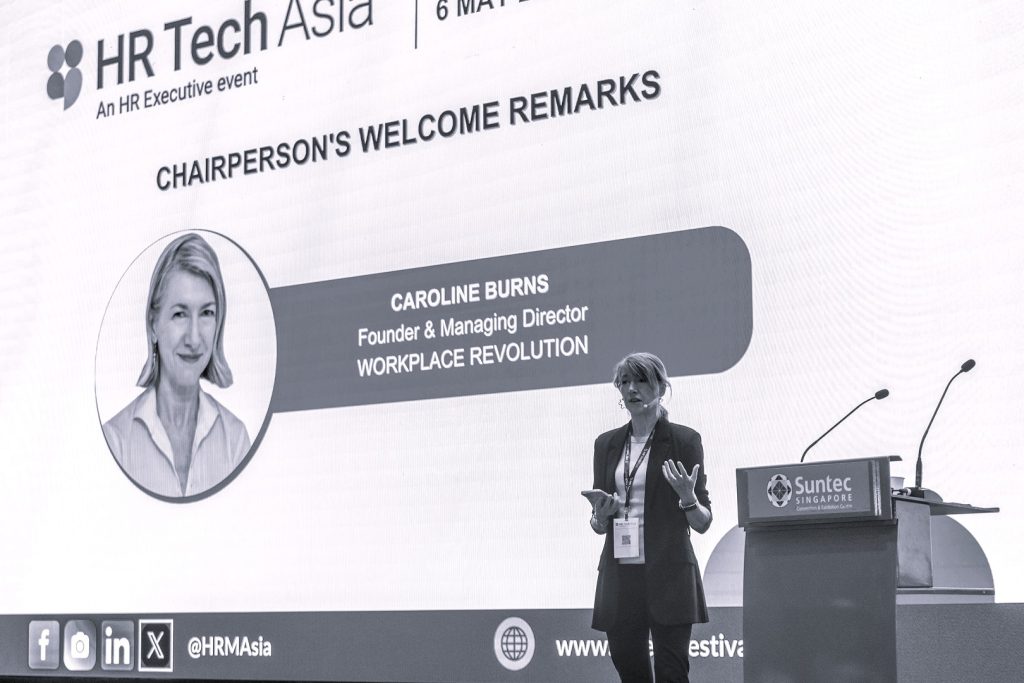
Chair’s Opening Session:
Hello! I’m Caroline Burns, your Chair for the HRTech Asia Worktech Excellence Track today and tomorrow.
We are all here because the world of work is at inflection point. Artificial Intelligence (AI) is part of the story – but not all of it. Work and the technologies we use to organise, perform, monitor and evaluate work have been evolving rapidly since 2000, and the pandemic lockdowns five years ago accelerated changes in personal workstyles, employee expectations, communication, work process and performance management.
Every leader I speak with and board that I am part of is looking for opportunities within this evolution to improve people’s ability to perform and deliver increased value to customers.
This morning during the summit keynote we heard from HR leaders how to employ bold HR strategies to stay ahead of macro trends and the evolving world of work. We learned about the five forces that are reshaping the foundations of people management, took peek inside next generation tools for HR digitisation and talent acceleration, and heard practical case studies and tips on transforming roles to meet evolving business needs.
During the remaining day and half of this summit the Worktech Excellence Track will build on these themes and drill deeper into future of work behaviours and workstyle transformation, featuring expert speakers and panelists on innovation & productivity, employee experience, flexibility and workplace wellness.
But before I welcome our first keynote, I’d like to share a couple of stories to illustrate the pervasiveness of this workforce transformation.
Anecdote 1 – AI versus Technician: the new imperative for problem-solving capabilities
I recently had a problem with a new induction cooktop we installed in our holiday house – it kept randomly yet stealthily turning off, which is a bit of a problem when you are trying to cook for family or friends!
Eventually we were able to get a technician authorised by the manufacturer to come and have a look. And this Tradie ummed and ahhed and obviously had no idea how to diagnose what was wrong. And admittedly he hadn’t worked on this model before, as it’s very new and not very common.
So, because he has no idea he orders in three new parts from Europe, one of which is the power control board which is effectively a chip with some fancy AI.
It takes 5 weeks to get the parts.
So, he comes back and replaces all three parts. And the original problem is fixed – although we don’t know which new part(s) were responsible because all three were replaced at one then tested together. But now we have a new problem – some of the hotplates don’t recognise when you put a pot on them.
Poor Tradie again has no idea, and his first thought is to try and leave, suggesting we monitor the situation over the next few weeks. Which doesn’t help us very much and only delays the inevitable. So instead, we guide him through some trouble shooting and a process of elimination to try and diagnose the problem and hence find a solution.
And we do identify the new issue. So now the induction works.
But that’s not the reason I’m telling you this story.
You’ve probably guessed the reason.
It’s because while the Tradie had some technical skills, he didn’t have what the World Economic Forum calls essential Future of Work cognitive capabilities of information gathering, analysis and problem solving. Capabilities that we need now more than ever.
In an age when almost everything we interact with, even a humble kitchen appliance, is powered by computers, and increasingly by AI, we can’t expect the Tradie to know how the AI works or to keep up a constant barrage of new features and models.
But, what he should be able (and trained) to do is listen carefully to the customer, diagnose the problem through a series of questions and steps, and offer possible solutions.
These capabilities would improve customer experience, decrease costs and resolution times for his employer, and improve the likelihood that he will be able to maintain relevance and not be discarded on the skills scrap heap.
Anecdote 2: From wilderness bootcamp to workplace: preparing for the future of work with essential skills and attitudes
My 15 year old nephew in Australia is currently into the 3rd month of a compulsory six month school boot camp with 60 of his classmates (all boys).
Similar to national service here in Singapore without the weapons!
The boys are allowed only two short trips home in this time, and NO technology – no personal phones, no access to social media, no access to Google or Chat GPT[i].
The boot camp is held in the wilderness in a large boys boarding school and they have regular lessons, but academic learning takes a back seat. Instead, the focus is all on building physical, intellectual, emotional and social flexibility and resilience.
Everything they do, from building bridges and boats, orienteering, mini-triathlons and three-day treks is with their dorm team. And while the boys are supervised for safety, they are usually guided only by what they need to achieve and why, with no help on the how. That’s up to a dozen 14-15 year old boys to figure out.
The teams are naturally highly competitive.
And they know the team is only as good as their weakest member.
They win together by working together, recognising that the collective work of the team will always be far superior to the individual skill or talent of a few members.
What they don’t realise they are learning are critical Future of Work attitudinal elements that underpin the confidence to achieve a goal – resilience, flexibility, self-awareness, motivation, curiosity and lifelong learning.[ii]
And the FoW cognitive skills – analytical thinking and creativity.
The school community knows from experience that instilling these capabilities at this age far outweighs the benefits of an additional 12 hours’ academic study every week for 6 months.
I am confident my nephew and his classmates will navigate the future of work with confidence.
The workforce of tomorrow, the people who will add real value to our organisations and help them respond, innovate and adapt in the face of ongoing uncertainty, complexity and ambiguity will need these essential cognitive and attitudinal strengths.
More than ever, these skills are needed to use AI intelligently and responsibly to enhance our potential, and not to replace our ability to think.
And this is why we are here, to equip ourselves as leaders with best practices, knowledge & ideas to help the people and organisation work with successfully navigate the journey of work transformation in the digital age.
Notes and References
[i] This was in early 2025 before the social media ban in Australia for under-16 year olds, so the boys were used to social media and increasingly AI being part of their daily lives.
[ii] World Economic Forum, The Future of Jobs Report 2023

Leave a Reply