
Read Time: 6 minutes
Peter Drucker first observed in a 1992 essay for Harvard Business Review that our great transformation to a society of knowledge workers would be completed by 2010 or 2020. Unfortunately, organisations still struggle to optimise performance by recognising and enabling the key requirements of knowledge work laid out by Drucker almost 35 years ago:
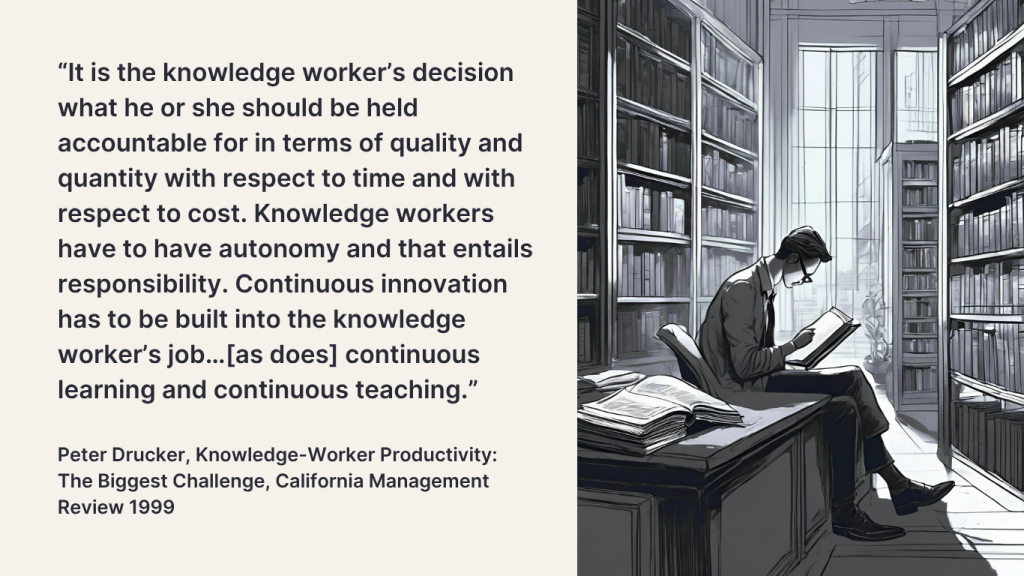
“It is the knowledge worker’s decision what he or she should be held accountable for in terms of quality and quantity with respect to time and with respect to cost. Knowledge workers have to have autonomy and that entails responsibility. Continuous innovation has to be built into the knowledge worker’s job…[as does] continuous learning and continuous teaching.”
Peter Drucker, Knowledge-Worker Productivity: The Biggest Challenge, California Management Review 1999
Since the pandemic lockdowns almost five years ago, office-based workers are more confident to try new things, to solve their own problems and more aware of how they produce their best work. We are starting to see the emergence of the knowledge worker as Drucker envisaged them – people who individually and in teams or project groups bring intelligence and a degree of autonomy to increasingly complex roles.
This complexity is not necessarily about technical expertise or skills, but increasingly driven by task unpredictability and diversity, information overload, resource scarcity and faster cycle times.
Whether the explosion in employee experimentation with large language models such as ChatGPT adds to or reduces complexity, or enhances autonomy, remains to be seen.[i]
In era of Industry 4.0, what we do we now define as successful performance for individuals, teams and organisations?
I discussed these questions with my colleague and co-presenter Dr Richard Claydon from EQ Lab a few years ago. Richard was a partner in Phrasia’s global “Voice of the Crowd” research into the work from home experience. Their deep AI analysis of open-ended responses revealed strong narratives within shared themes and highlighted the complexity and uniquely individual experience of knowledge-driven work.
What work may look like in future must be driven by what we redefine as successful performance – and what the enablers of that performance need to do over time.
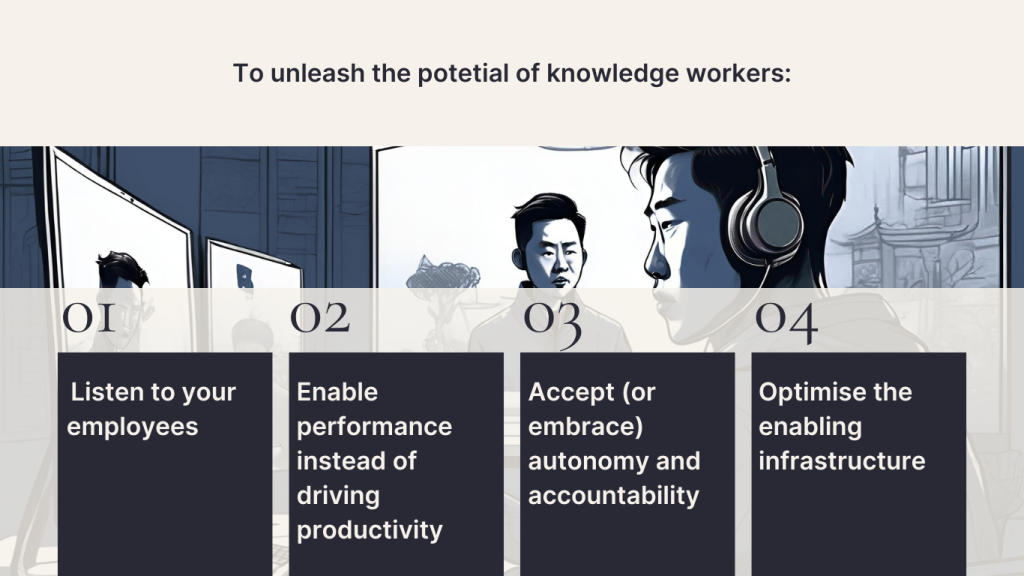
1. Listen to your employees
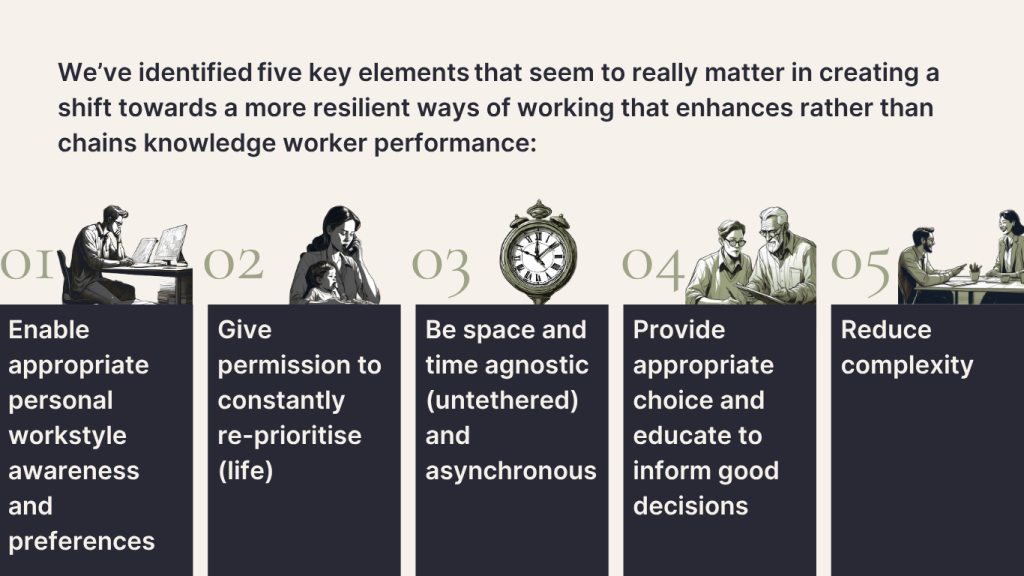
They are increasingly aware of how they work best and what ‘effective performance’ means for them.
Organisations are increasingly faced with customer and employee segmentation into smaller and smaller clusters. Sharing responsibility for optimising the workplace experience at a granular level between organisations and individuals is likely to yield significant benefits for both.
Global research by ServiceNow reveals that 92% of executives acknowledge they were forced to rethink how they worked during lockdown and 87% of employees said this new way of thinking about business was an improvement. People were ‘forced’ to learn new skills in terms of technology and – more importantly for the future – develop new capabilities, including learning and experimenting ‘as-you-go’, problem solving, decision-making, conscious communication, empathy, self-motivation and prioritisation, and leadership (at all levels and in many guises).
These are the critical skills widely acknowledged to be essential for knowledge work in the digital age. Industry must invest in uplifting knowledge worker performance to improve productivity at organisational and national levels and stave off the stagnation that has encouraged cost-cutting and share buybacks to boost profitability.
These future of work skills are immensely valuable to individuals in terms of job security and to organisations seeking the optimum balance between humans and machines to be more insightful, more innovative, faster and more sustainable.
However, in the relentless drive towards efficiency many organisations have sacrificed knowledge worker performance and the ability to respond adequately to VUCA. As Professor Lynda Gratton noted some years ago in a future of work conference keynote, we need to “listen to the job” and create environments that support the jobs of the future, not the jobs of the past.
If your organisation has been reluctant to engage and seek feedback from your employees until you ‘are ready’, you are probably going to be waiting a long time. Seeking qualitative, anecdotal feedback is just as valuable as company-wide surveys. Ask what’s working and not working, not just when or how many days employees want to come back to the office (the responses to these questions can be very misleading – buts that’s a whole other article!).
2. Enable performance instead of driving productivity
If you only measure what happens in offices, it will be difficult drive a broader approach to supporting people’s best work anywhere.
Ask HR if they are reviewing performance measurement, reward, and recognition policies to effectively support remote as well as ‘in-office’ work.
Instead of measuring increases in office productivity resulting from engagement-seeking perks, organisations should focus on supporting key cultural, digital, and physical performance enablers and critical success factors.
This will require joint recognition by human resources, real estate, and technology that the cultural, digital, and physical work environments are intertwined in employee perceptions of performance and satisfaction .
The results of the Phrasia and other research (such as Leesman’s H-Lmi surveys), highlights the interrelatedness of these workplace enablers and complexity of employee experience.
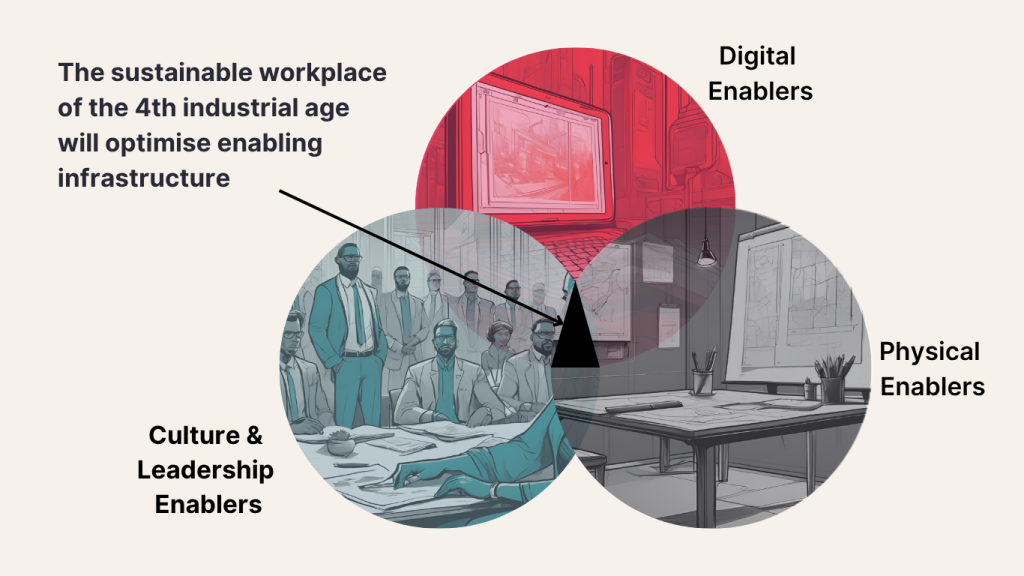
Leaders must seek to optimise how these three dimensions interact to reinforce or undermine the entire performance environment. They must also be more conscious about the risks of driving efficiency in one enabler – such as increase in desk sharing ratios – and undermining the effectiveness of another enabler – such as lack of investment in a booking and wayfinding app. The optimal balance will be unique to every organisation (this is also a whole other subject, which I explored in my PhD thesis).
3. Expect autonomy and demand accountability
By regarding the workplace as a system comprised of cultural, digital and physical enablers, our team have been able to reframe the criteria for a “good” workplace experience that supports individual and team performance.
We refer to this approach as creating a personalised adaptive workplace system. To transform knowledge worker performance, accept that you do not have all the answers and probably never will. Instead consider the workplace to be a critical part of an adaptive system of physical, digital, and cultural performance enablers that your employees are empowered to leverage in different ways at different times to optimise their productivity.
4. Optimise the enabling infrastructure
Successful and sustainable organisations are built for destabilisation and organised for innovation and change.
Recent years have revealed the fragility of many of our organisational and institutional systems – built for efficiency rather than for adaptive performance – during periods of unprecedented geo-political, social or technological upheaval (including ‘black swan’ events), when assumptions and mental models become less useful, if not deceptive.
To achieve the resilience needed to respond to change, we must also be prepared for the “systematic abandonment of whatever is established.” Our cities, communities, and our organisations are complex systems – and in that complexity lies both unpredictability and volatility but also agility and resilience.
The last five years of volatility and unpredictability have revealed the risks of engineering the **** out of organisational resources – people, process or property – in the pursuit of efficiency. Smart boards and leaders have learned that efficiency tends undermine effectiveness and flexibility – what I call “wiggle room” to adjust, adapt and regenerate when circumstances render old paradigms obsolete.
Ask, experiment, learn, tweak, and monitor to constantly fine-tune the system and maintain its robustness. Look for unforeseen consequences of workplace initiatives – both positive and negative – as this is where we often find hidden opportunity and strategic value.
It is high time leaders started acting like the clock is running out. Embrace the momentum of social and technological change to propel yourself and your people fully into the digital age by transforming office work into knowledge work.
If this feels worth exploring further, I’d welcome the conversation.
Caroline M Burns
Note
[i] Fast forward to 2026 and the flood of individual and enterprise applications that now incorporate some form of “AI” have yet to deliver significant productive or financial benefit, although company and industry specific cases exist, and leadership expectations remain high, especially in certain industries. The transformational impact of AI on knowledge worker capabilities and workstyles also remains unknown at this stage. Refer also to The Regenerative Edge editions: 6 Reasons Boards Must Integrate the AI Future of Work into Strategy and Integrating Generative AI to Amplify Human Potential in the Workplace.

Leave a Reply