
Read Time: 7 minutes
Growth is not the Same as Scale
“We’re growing fast – so why does it feel like we’re more fragile, not stronger?”
This is an all-too common concern that keeps leaders and founders awake at night. And it’s not theory for me either – I’ve built and led companies that have suddenly taken off, and while the success is fantastic, it’s like drinking from a fire hose!
When we think of growth, we assume more customers and more revenue, more people, more inventory, maybe bigger premises.
We should not equate these highly visible signs of growth with scale and maturity.
Or with profitability.
Or with business sustainability.
These are not automatic results of growth. In fact growth might hinder progress in these areas – at least for a while.
But growth is good, right?
Yes, growth is healthy for business, and ideally it propels a company to the next level of business maturity that improves margins and decreases revenue risk through a combination of diversification, depth, or dominance. Growth should make a business more sustainable because it builds the capacity to better withstand shocks and better respond to opportunity.
However, scaling doesn’t happen automatically when your headcount or revenue goes up – it’s what happens when the systems, governance and leadership models underneath your business are built to handle what’s next, not just what’s now.
The organisations that scale sustainably aren’t the ones getting today right; they’re the ones asking, at every stage, what will break this at twice the size – and building for that answer before they’re forced to.
It means preparing for not just for growth, but for the next level of firm maturity as that growth stabilises into a new business as usual.
Effective leaders and boards know what works at this stage of a firms’ development may actively work against you at the next stage, so the job isn’t just doing these things well, it’s knowing when each one needs to change.
Sustainable scaling means always looking ahead for when the next gear shift needs to happen.
In the first of this three-part series we will work through the influence of business context on what good scaling looks like, the importance of good governance and what can happen when this is not in place, and the importance of staying a step ahead in financial maturity. In part two we cover where scaling breaks day to day and the operational discipline needed to contain this, and in the final part I flag some warning signs and structural strategies that strengthen scaling tactics and build the foundations for sustainable growth.
Follow the Money
Growth needs to be funded, and the capital structuring model of your business at each stage of growth is a critical consideration.
Why?
Because capital sources have expectations that affect what sustainable scaling means.
For example, bank debt comes with covenants and reporting discipline; venture capital (VC) comes with growth-at-speed expectations and often with board seats; private equity (PE) often includes control rights and operational involvement; employee shareholders want risk-managed revenue and margin growth, and family/friends’ money and bootstrapping come with informal but sometimes more personally fraught expectations.
The matrix below outlines the differences in growth expectations for the six most common capital funding sources. Most businesses are a blend of a couple of these sources, and evolve the mix as the business matures. In this series I’ll focus mainly on the first four where I have the most direct experience, but the insights and tips will be relevant across the board.
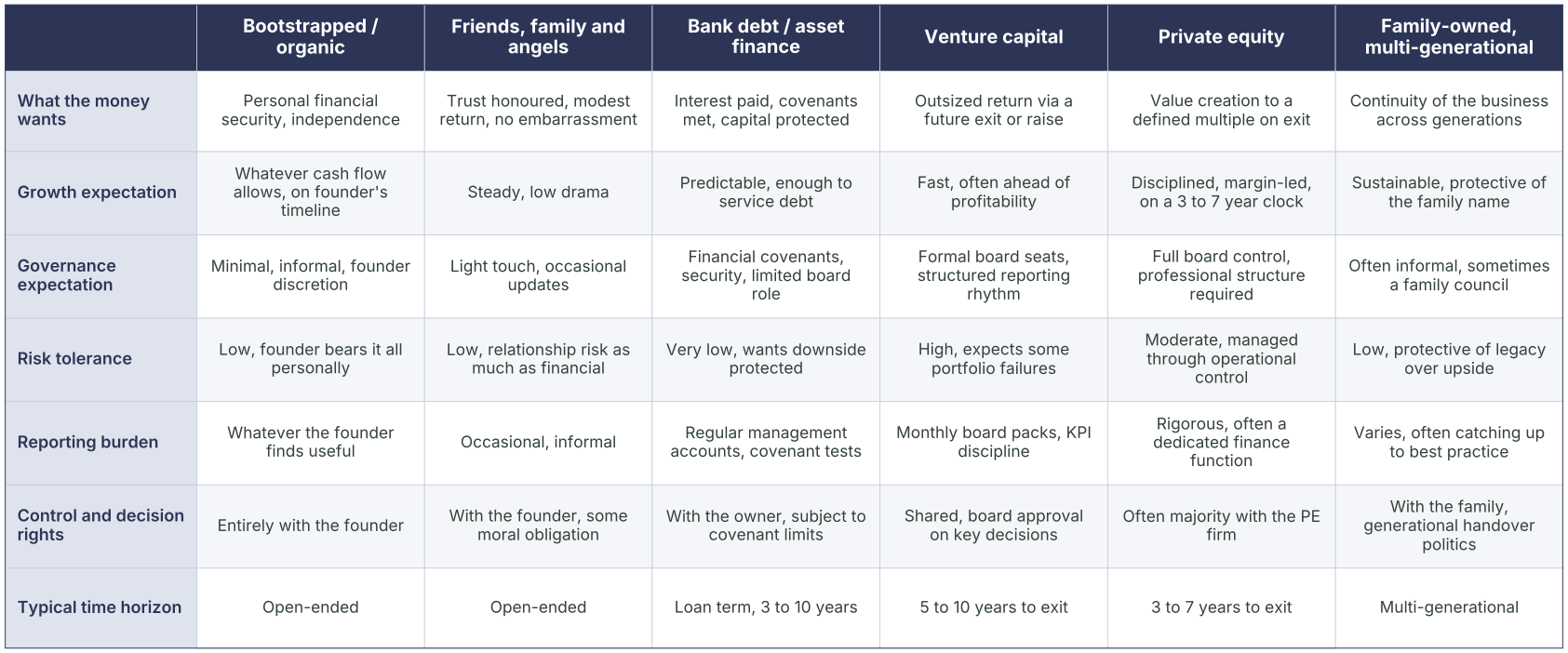
One firm I advise shows exactly how these different expectations play out in scaling strategy. The company has an ambitious five-year strategy: new geographies, new service lines, mostly organic growth. That means investing in new roles, offices, and capabilities well before the revenue to justify them arrives – alongside a parallel commitment to strengthening quality management, which the company treats as foundational to expansion, not optional. To fund it, employee shareholders – people motivated to grow the business they both work for and own – approved dividend reinvestment, partial use of retained earnings, and a modest increase in loan facilities, while keeping the balance sheet strong enough to weather a downturn. Unlike VC or PE investors, they’re comfortable trading some short-term return for lower risk and longer-term sustainability, and because they’re inside the business day to day, they understand exactly which levers they’re pulling, and why.
The transitions between capital sources matter more than getting everything perfect for each investor. This is where growth expectations, risk tolerance and control, and decision authorities can shift significantly. The resetting of governance and reporting expectations as you move up a gear is where many founders and leadership teams are caught out.
Governance as Gearshift, not Handbrake
Governance is not something that only bigger companies need to do.
Corporate governance guides how a company is directed and how it relates to shareholders and stakeholders. Even if you are a solo-preneneur not quite ready to hire your first employee, you have shareholders (even if this is simply yourself and your savings), and stakeholders such as customers, suppliers, future staff and investors, the community or industry etc.
“With the right structure and systems in place, good corporate governance enables companies to create an environment of trust, transparency and accountability, which promotes long-term patient capital and supports economic growth and financial stability.”
In other words, good governance helps build the right behaviours and decision-making lens as the company scales. Build early rather than when it becomes a remediation issue – a lesson I learned the hard way.
I started my first company at 28. About five years in, a much older, more established, high-profile colleague – let’s call him Robert – suggested we merge our businesses.
As a sole proprietor, I’d built solid systems and was diligent, if naïve, about compliance. I assumed someone with Robert’s experience would take it up a notch. When I joined his company as a director and minority shareholder, neither of us paused to establish clear reporting practices, decision-making authority, financial delegations, workplace policies, or a way to resolve conflict. You can guess the rest.
The business didn’t fail. Leadership and management failed.
The real damage wasn’t what I walked away with – it was that both our reputations were bruised, and a professional relationship was destroyed inside a small, specialised industry where everyone knew everyone. Now imagine that same failure inside a larger company that had acquired its way to the scale needed to attract PE or go public.
My business bounced back quickly. The lesson didn’t leave.
Governance can’t wait till the company scales, it’s hard to bolt on as an afterthought. Good governance is silent when things are going well, but lack of governance becomes very visible when something goes wrong.

One of the greatest benefits of putting a governance system in place early (even a very simple and modest set of principles or policies) is that it makes you think about leadership’s responsibility to anticipate and mitigate a broad range of risks that will impact different stakeholders and thwart growth ambitions.
Governing for growth naturally requires a more mature financial reporting system. This is often what breaks first, especially if you have investment sources beyond your own capital. The relative informality of financial reporting in companies with turnover in the hundreds of millions has sometimes surprised me. Equally I have been impressed by the depth and rigour applied to management accounts, KPI tracking, shareholder and board reports in much smaller businesses.
In the companies I have led or advised good financial governance means putting in place and gearing up the systems you will need at the next level of growth.
Don’t need to be independently audited yet? Have your accountant conduct an informal review and suggest chart of accounts adjustments 12-18 months before you plan to reach the size threshold.
Don’t feel you can justify a board right now? Start smaller: owners and shareholders have different rights and expectations to executives – even when they’re the same people wearing different hats. Set up a separate cadence, annual or bi-annual, for shareholders and investors only, with financial and business reporting packs issued in advance. You’ll likely find the questions and priorities are nothing like the ones in your regular management meetings.
Alternatively, you could investigate the benefits of an independent CEO or leadership team adviser (or advisory board) to review, challenge and feedback on performance and strategy implementation. Governance gaps will quickly reveal themselves to an external expert.
Ready to hire your first staff member? Write the contract as if this was your tenth or twentieth hire – treat typical terms as standard (employment regulations will likely dictate a lot of this) and deal with the nuances in customised schedules you attach. Try to include a broad range of employment circumstances – it’s easy to ignore or delete those that don’t apply for a specific role or individual. And have your lawyers look over the standard terms – when you know they stand up to legal review you can be confident in the legality and fairness of your template.
I recently advised a founder about to make his first few hires. He was justifiably worried that with new-starters landing in quick succession, he wouldn’t have time to onboard each one properly without the business grinding to a halt. So instead of treating onboarding as a one-off task to survive, we treated it as an asset to build. For hire number one, we used the process to formalise what had lived only in his head: vision and values, workstyle expectations, policies, and procedures. Each hire after that built on and refined it. The result: faster time to productive work, a stronger new-starter experience, and most importantly, time back for the founder to shift from operator to growth-focused CEO.
Capital will fund business growth. Good governance will enable and sustain it.
When the world is moving at breakneck speed, it helps to have clear communication flows between shareholders/investors, directors and management, and know where responsibilities and accountabilities lie. Combined with a relevant and regular reporting system that anticipates future performance, and processes that make what’s in your head explicit and repeatable, these foundations will help your company stay the course while scaling at speed.
You get there by anticipating this stage of business development before it happens, by asking a year or two earlier “what would break at twice our current size?” and then using every available opportunity to build out the scaffolding that will be needed to support a bigger business.
The opportunities and operational disciplines that help prevent fractures and failures will be explored in Scaling Without Breaking – Part 2 The 5 Disciplines that Reduce Growing Pains. If you’ve subscribed to The Regenerative Edge and checked post-related notifications in your profile settings, you’ll receive an email when Part 2 is available. Otherwise, keep an eye out for my update in your LinkedIn feed or on my landing page here.
If this feels worth exploring further, I’d welcome the conversation.
Caroline M Burns
Some company and situational details in the examples shared have been changed or blended with other cases to best illustrate the point and protect confidentiality.
A shorter version of this article was also published in the September-October 2026 edition of my newsletter The Regenerative Edge.

Leave a Reply